
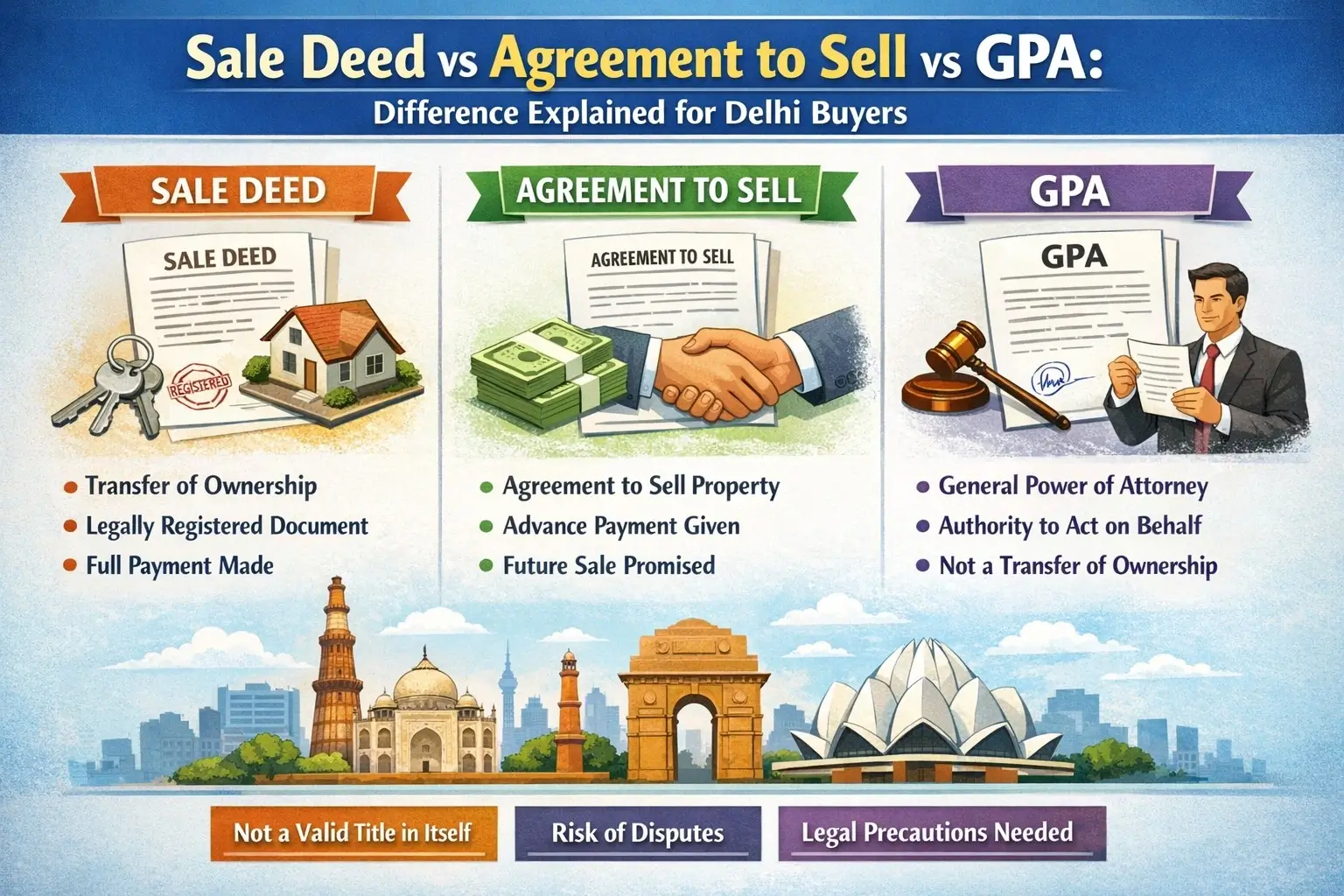
In Delhi real estate, few things confuse buyers more than document language. A seller may say, ‘The papers are complete,’ but the file may include only an Agreement to Sell, a GPA, some receipts, and perhaps a will. For many buyers, that sounds close enough to ownership. Legally, it is not the same thing.
Under Indian property law, a sale deed is the document that actually conveys ownership in immovable property. An agreement to sell records a promise to transfer later on agreed terms. A General Power of Attorney, or GPA, creates an agency relationship and authorizes one person to act on behalf of another. By itself, it does not transfer ownership.
The simple version
Think of it this way: a sale deed is the final ownership transfer document. An agreement to sell is the contract that says the property will be sold later on agreed conditions. A GPA authorizes one person to act for another, but is not a title document on its own.
What is a sale deed?
A sale deed is the document that completes the sale. It is the instrument through which the seller legally transfers rights in the property to the buyer. In practical terms, this is the document banks, future buyers, and legal professionals check first when they ask the most important question in a transaction: who has title?
In Delhi, buyers should treat the registered sale deed as the anchor document in the ownership chain. It is the clearest evidence that ownership has been formally conveyed.
What is an agreement to sell?
An agreement to sell is a pre-transfer contract. It usually records the names of the parties, the property details, price, earnest money, timeline, default clauses, and the promise that a proper sale deed will be executed later. It is an important transaction document, but it is not the same as legal title.
For buyers, this distinction is critical. An agreement to sell may create contractual rights and may support a claim for specific performance in the right circumstances, but it does not by itself make the buyer the owner of the property.
What is a GPA?
A GPA, or General Power of Attorney, is an authorization document. It allows the attorney-holder to act on behalf of the principal, depending on how it is drafted. In property matters, it may be used for convenience when the owner cannot personally sign or appear. But a GPA is not, by itself, a document that transfers title.
This is where many buyers in Delhi get confused. They see GPA papers and assume ownership has already changed hands. In law, that is not the correct way to read the document. A GPA can authorize action; it does not automatically create ownership.
Which document actually makes you the owner?
For a standard sale transaction, the safest answer is simple: the registered sale deed. If a file relies mainly on an agreement to sell, GPA, receipts, or similar papers without a completed conveyance, a buyer should not treat that file as clean title without deeper scrutiny.
Why this matters so much for Delhi buyers
Delhi property transactions often involve old paper trails, family arrangements, conversions, and legacy document sets. That is why document hierarchy matters so much. A beautifully finished property can still become a serious legal problem if the title trail is weak or incomplete.
A buyer in Delhi should treat the sale deed as the ownership document, the agreement to sell as a pre-transfer contract, and the GPA as an authority document only. These papers may all appear in one file, but they do not do the same job.
What should buyers verify before paying token money?
Before paying a token, ask for the full title chain, not just one or two front-page papers. Review the latest registered sale deed or conveyance document, earlier title papers where relevant, the seller’s identity and capacity, mutation or tax records where available, and any GPA only to check whether the person signing is genuinely authorized to act for the owner.
A simple rule works well here: do not confuse transaction papers with title papers.
Final word
For Delhi buyers, the difference between these three documents is not technical; it is fundamental. A sale deed transfers ownership. An agreement to sell records the promise and terms of a future transfer. A GPA authorizes someone to act, but does not by itself make that person the owner. If the file relies mainly on an agreement to sell and GPA, it should be treated as a case for deeper legal and practical due diligence before any money is committed.
Related reading
Related guides on this site: