East facing vs west facing house is one of the first filters Delhi buyers apply, and one of the most misunderstood. The direction a floor faces is fixed by the plot long before a wall goes up. What it changes is not the quality of the home. It changes when the sun reaches each room, which bedroom is warm at seven in the evening, and how hard the cooling has to work between April and June.
In a builder floor the question is sharper than in an apartment tower, because every floor in the building shares the same orientation and there are only four or five homes to choose from. You cannot move to a better-facing stack in the same complex. This guide covers what the direction actually changes, what a developer can and cannot do about it, and how to check a floor for yourself in ten minutes on a visit.
What facing means in a builder floor
Facing is the direction of the side the main entrance sits on. It is set by which side of the plot the road runs along, and it stays the same for every floor in the building. A west-facing building gives you west-facing floors.
The mistake is to read facing as a description of the whole home. It is not. On a narrow plot with buildings on both sides, a floor has one real open face and two shoulders that get very little direct sun. On a wider or corner plot, rooms may open to two or three sides, and then the plan matters as much as the facing. A west-facing floor with living and dining on the west and bedrooms on the east behaves completely differently from a west-facing floor with the plan reversed.
So the useful question is not “is this house east or west facing”. It is “which rooms get the morning sun, which get the evening sun, and where will the family be sitting at the time”.
Why a west wall behaves differently in Delhi
Delhi sits at roughly 28.6 degrees north. Through the year the sun rises almost due east and sets almost due west at the equinoxes, but in May and June it sets well to the north of west, and in December it sets to the south of west. The practical effect is that a west wall takes direct sun late in the day for much of the year, at a low angle that reaches deep under a shallow overhang.
Brick and concrete also hold heat. A west wall absorbs through the afternoon and gives it back into the room in the evening, which is exactly when the family sits down and the cooling starts. An east wall takes its sun in the morning, when the air outside is cooler, and is in shade from early afternoon.
The other two directions matter less than buyers expect. A north face gets almost no direct sun at any time of year. A south face gets low winter sun, which is welcome in January, and very little in June, when the sun is high overhead.
What an east facing vs west facing house gives you, room by room
| What you notice | East-facing rooms | West-facing rooms |
|---|---|---|
| Morning light | Strong from sunrise, cool and low | Dim until around midday |
| Afternoon heat | Shaded from early afternoon | Direct sun until sunset |
| Evening | Cooler and darker earlier | Warm and bright until late |
| Balcony or terrace use | Best at breakfast | Best after sunset, hot in May and June |
| Winter | Cold mornings, bright by nine | Pleasant warm afternoons |
| Bedrooms | Early light, wakes light sleepers | Warm at bedtime in summer |
| Kitchen | Light through the morning | Hot during the evening cooking hour |
| Effort to keep cool | Lower | Higher unless the west side is shaded |
Read the table as a description of timing, not of quality. A west-facing living room is the better room in December and the harder room in June. An east-facing bedroom is a pleasure if the household wakes early and a nuisance if someone works nights.
What can be changed, and what cannot
Nothing changes the plot. The road is where it is, the plot’s long axis is what it is, and the entrance faces the side it faces. A developer cannot rotate a building, and a buyer cannot rotate a floor afterwards.
Almost everything else is a design decision, and most of it is made before you arrive:
- Deep balconies and projections over west windows cut the low afternoon sun before it reaches the glass.
- External blinds or louvres on the west face do more than any curtain fitted inside.
- Glass specification matters. A west window with ordinary clear glass and no shade will heat the room; the same opening with solar-control glass and an overhang behaves very differently.
- Roof treatment matters on the top floor, where the slab above adds heat on top of the wall gain.
- Cross ventilation, if the plan allows it, lets the evening air move through instead of sitting in the rooms.
- Trees and planting on the west side take years to work, but they work.
This is why two west-facing floors in the same colony can feel like different homes. Ask what was actually built: the depth of the balcony, the glass, the shading, the roof. Not what could be added later.
The Vastu question
Many Delhi families ask about direction for reasons that have nothing to do with heat. That is a real consideration and it deserves a straight answer rather than a sales line.
Vastu is a tradition and a family preference, not a building rule and not a legal requirement. Practitioners differ on what matters, and many treat the direction of the main entrance and the placement of the kitchen and pooja room as more significant than the facing of the building as a whole. What we will not do is tell you that one direction is auspicious and another is not, because that is not ours to decide.
If direction matters to your family, settle it before you shortlist rather than after you have seen three floors. Look at the entrance, the kitchen and the room you would use for pooja, and check whether the plan can meet what your family follows. Then go back to the practical questions.
How to check a floor for yourself on a visit
- Ask for the floor plan with a north arrow, not the brochure render. Most plans have one, and it settles the argument in a second.
- Use the compass on your phone at the main door, then again at the windows of the rooms you will actually use. The two do not always agree in a corner building.
- Visit between three and five in the afternoon in April, May or June if you can. A morning visit flatters a west-facing floor.
- Stand in the room you would use in the evening and feel the wall. A west wall that is hot at five will still be warm at nine.
- Look at what sits to the west of the plot. An open plot, a park or a low building means more afternoon sun. A taller neighbour means shade, at least until it is redeveloped.
- On the top floor, ask what is above the ceiling and what has been done to the roof.
- Open two windows on opposite sides and see whether air moves through. This tells you more about summer comfort than the facing alone.
Does the floor level change the answer?
It changes it at the top and the bottom. A top floor takes heat through the roof slab as well as the walls, so a west-facing top floor is the hardest combination in the building unless the roof is treated and shaded. A ground floor loses some direct sun to boundary walls, the stilt and neighbouring buildings, which softens a west face but can leave the rooms darker through the day.
The middle floors are the most predictable. They get the wall gain of their orientation and little else, and what you feel on a visit in May is close to what you will feel in July.
If you are choosing between two floors in the same building
Compare like with like. Same plan, same floor level, different side of the building is the only comparison that isolates direction. If the plans differ, you are choosing a layout, not a facing.
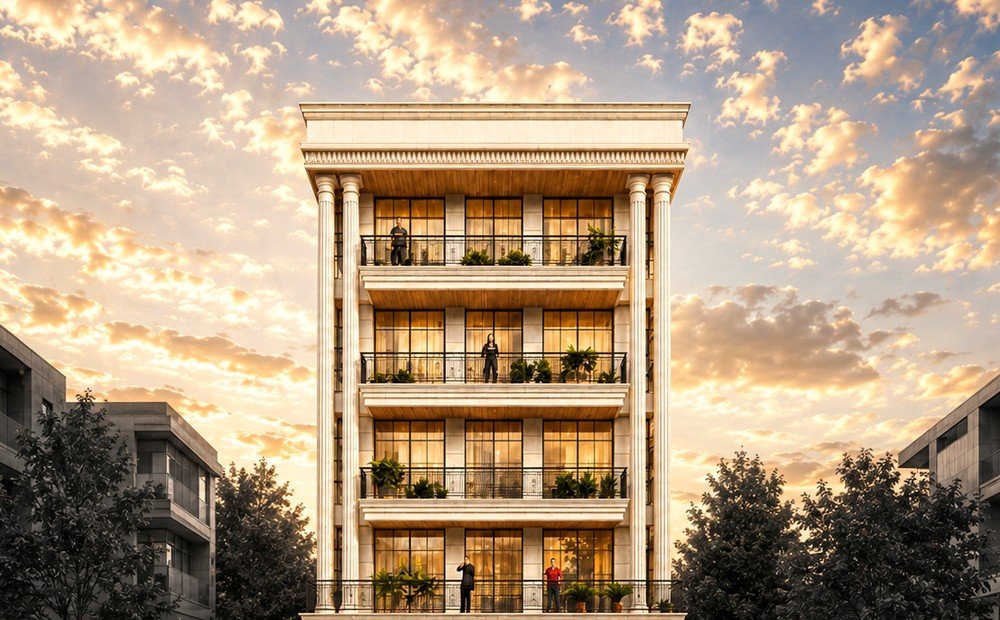
Samriddhi at D-58, Nangal Dewat is a west-facing building, so its floors take the evening sun. A family that wants morning light should look at what the floor actually opens onto, and at how the west side has been shaded, rather than at the label alone. You can see the building and the floor plans on the Samriddhi residence page, and the wider set of floors on the South Delhi builder floors page.
What it comes down to
Direction decides when the sun arrives and how much the cooling has to do. It does not decide whether a home is well built, well planned or worth buying. A shaded west-facing floor with a good plan is a better home than an unshaded east-facing one with a poor plan, and both exist.
If you want the orientation, the floor level and the shading of a specific home in front of you rather than in general, tell us which direction your family prefers and we will send the floors that match it, along with what is currently available. You can also start with what a builder floor actually is if this is your first purchase.