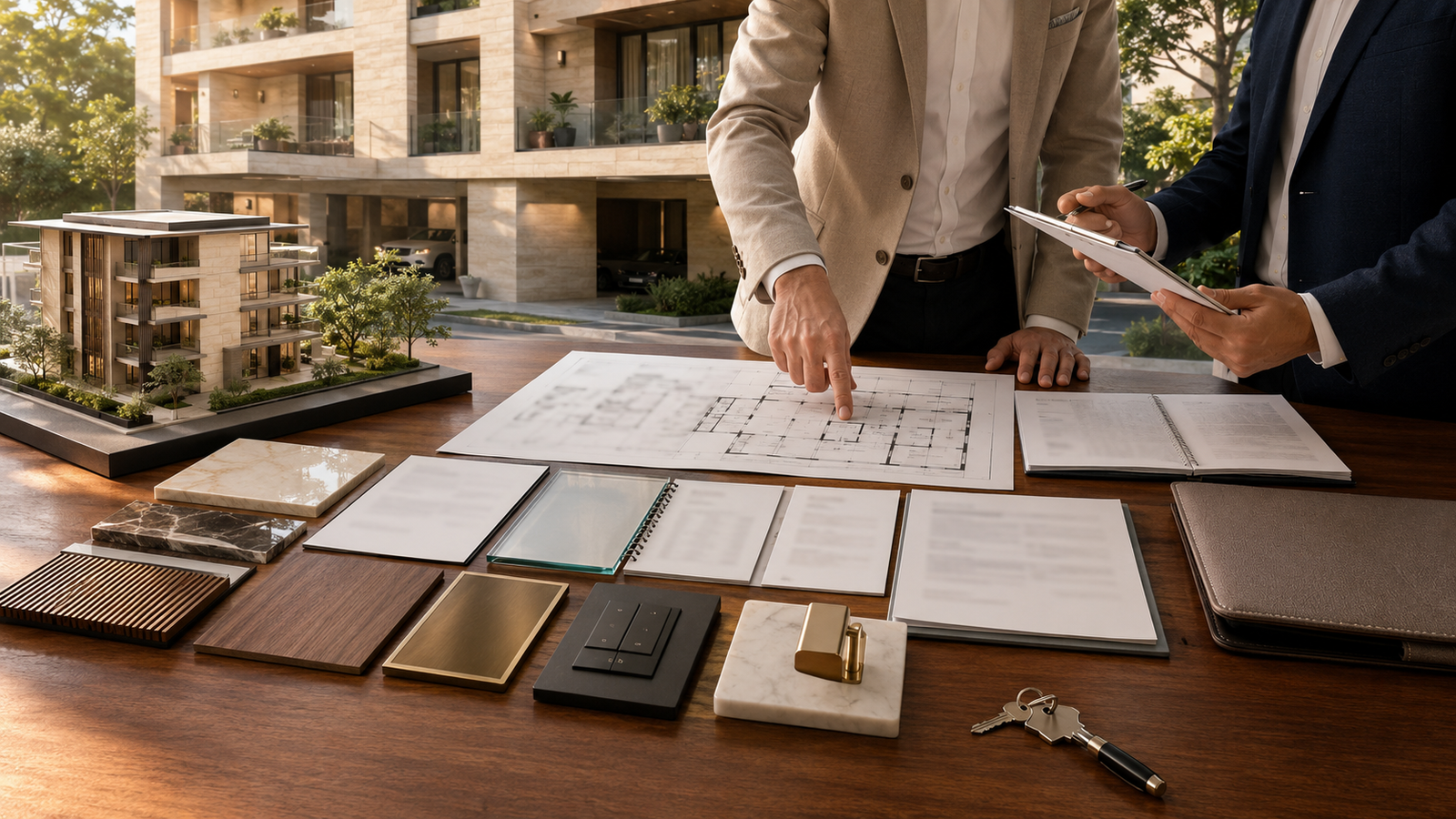
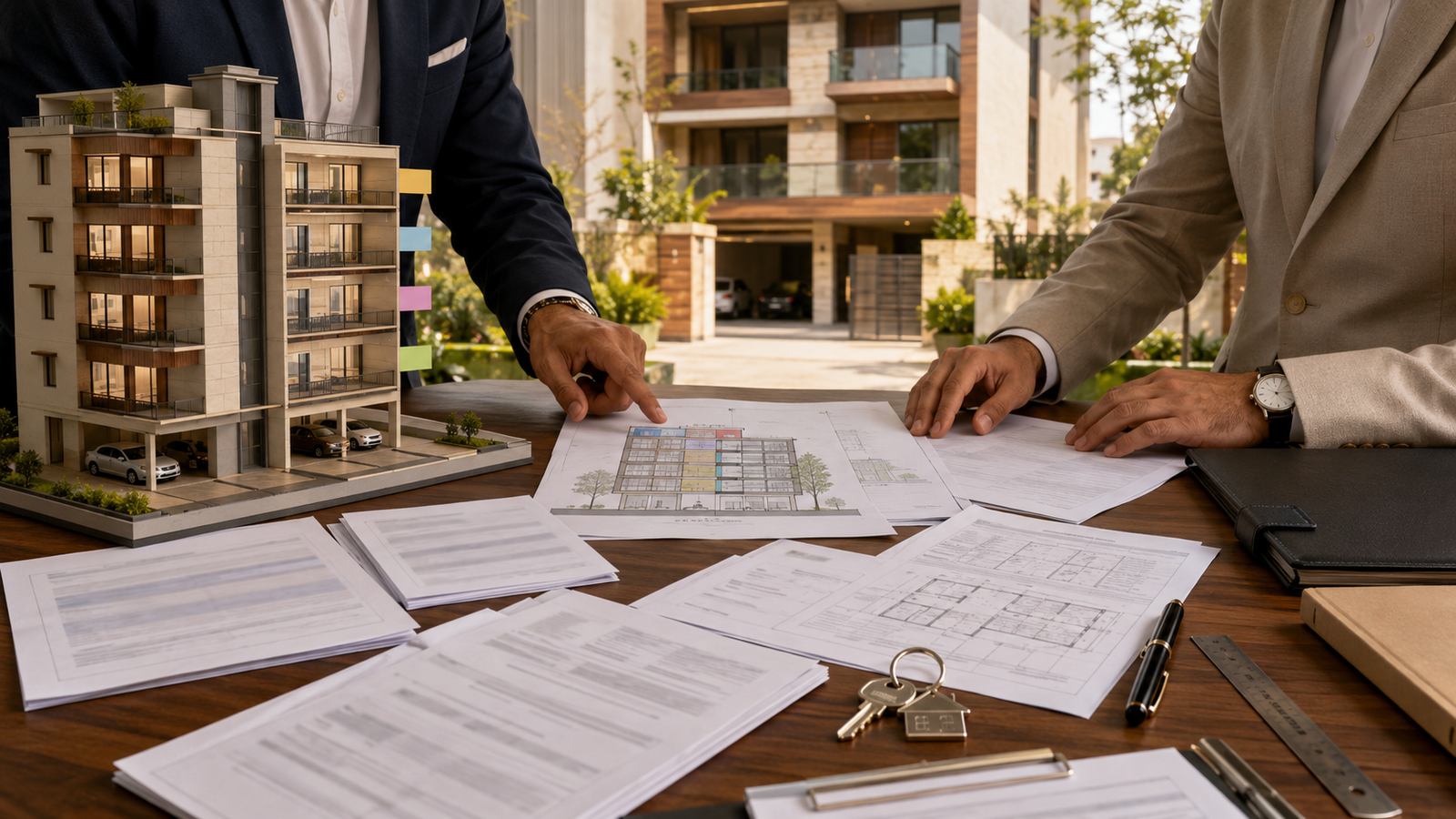
A builder collaboration agreement Delhi buyers encounter usually involves a plot owner allowing a developer to demolish or redevelop an existing property. In return for constructing the new building, the developer may receive one or more floors, a monetary payment or a combination of both.
The remaining floors may stay with the original landowner. Parking spaces, terrace rights, land share, common areas and responsibility for selling individual floors may also be divided between the parties.
This arrangement is common in Delhi’s plotted residential market, but it creates an important buyer question:
Does the person accepting your token amount have the legal and contractual authority to sell the specific floor being offered?
Before booking a collaboration builder floor, buyers should examine the ownership documents, development agreement, floor-allocation schedule, power of attorney, sanctioned plan and proposed sale deed together.
The collaboration agreement alone does not replace the final registered document required to transfer ownership. Under Section 54 of the Transfer of Property Act, a sale of immovable property of the relevant value is completed through a registered instrument.
What Is a Builder Collaboration Agreement Delhi Property Owners Use?
A builder collaboration or development agreement is a contract between the landowner and developer describing how an existing plot will be redeveloped.
The agreement may define:
- Who will finance the construction
- Who will obtain or coordinate approvals
- Which party will appoint the architect and contractors
- Which floors belong to the landowner
- Which floors become the developer’s share
- How parking will be divided
- Who receives terrace rights
- Who may sell each floor
- How sale proceeds will be handled
- Construction specifications
- Completion timeline
- Temporary accommodation or rent for the owner
- Defect and warranty responsibility
- What happens if either party defaults
There is no universal allocation formula. One project may give the developer one floor, while another may allocate multiple floors or a percentage of the sale proceeds.
The buyer must therefore review the agreement for the specific property instead of assuming that every collaboration project follows the same model.
Why Floor Ownership Can Become Confusing
In a normal resale transaction, the registered owner sells the property directly.
A collaboration project can involve several parties:
- Original plot owner
- Joint or family co-owners
- Developer or construction company
- Power-of-attorney holder
- Broker or sales representative
- Lender with a charge on the property
- Contractor with unpaid claims
- Buyers of other floors
The person marketing a floor may have constructed it without being the original owner of the land. Alternatively, the landowner may be selling a floor that was contractually allocated to the developer.
This is why buyers must establish three separate facts:
- Who legally owns the underlying property?
- Which party was allocated the selected floor?
- Who has authority to execute the registered sale deed?
Do not treat these as the same question.
1. Verify the Original Plot Ownership
Begin by reviewing the current ownership document for the complete plot.
Ask for:
- Current registered sale or conveyance deed
- Previous title documents
- Mutation records
- Property-tax records
- Identity documents of all owners
- Partition or family-settlement documents, where relevant
- Probate, succession or relinquishment documents, where relevant
- Conversion documents for leasehold properties
- Permission from the lessor, where applicable
Delhi’s Revenue Department permits online searches of previous property-registration details and provides deed-search and encumbrance-search facilities through its official systems.
The names on the collaboration agreement should be compared with the names in the ownership chain. When the plot has multiple owners, verify whether every required co-owner signed the agreement or legally authorised someone to act on their behalf.
A property lawyer should independently examine the title rather than relying only on photocopies supplied by the seller.
2. Read the Complete Collaboration Agreement
Request the full agreement, including all annexures, schedules and amendments.
Do not accept only the page showing the developer’s floor allocation.
The document should be examined for:
- Exact plot description
- Names and capacities of the parties
- Date of execution
- Construction obligations
- Developer consideration
- Floor-wise allocation
- Parking allocation
- Terrace rights
- Land share
- Authority to market and sell
- Power to receive money
- Responsibility for approvals
- Completion deadline
- Default and termination clauses
- Dispute-resolution terms
- Amendments made after execution
The stamping and registration requirements applicable to a development or collaboration arrangement can depend on the document’s language, rights granted, possession terms and local law. A Delhi property lawyer should verify whether the specific agreement was properly executed, stamped and registered where legally required.
3. Confirm the Floor-Allocation Schedule
The most important part of a builder collaboration agreement Delhi buyer review is the floor-allocation schedule.
It should identify which party receives:
- Ground or upper-ground floor
- First floor
- Second floor
- Third or top floor
- Basement, where applicable
- Servant rooms
- Storage areas
- Stilt parking spaces
- Terrace usage
- Common facilities
- Undivided land share
The floor being sold should be clearly included in the seller’s allocation.
Avoid relying on verbal statements such as:
- “This is the builder’s floor.”
- “The owner has already agreed.”
- “The allocation will be changed before registry.”
- “All family members know about the sale.”
Ask for written proof.
If the original agreement was later changed, request the supplementary or revised agreement. The amendment should be signed by all parties whose rights are affected.
4. Check the Builder’s Authority to Sell
Receiving a floor under a collaboration arrangement and having authority to sell it are related but distinct issues.
Review whether the developer has:
- A contractual right to sell the allocated floor
- An authenticated power of attorney, where required
- Authority to sign the agreement to sell
- Authority to receive the token and purchase consideration
- Authority to execute or participate in the sale deed
- Authority to hand over possession
- Authority to provide warranties
Delhi’s Revenue Department explains that a registration document may be presented by the person executing it, their representative or an agent duly authorised through a recognised power of attorney.
However, a power of attorney should not be confused with ownership itself. Its purpose is to authorise specified acts on behalf of the principal. The final ownership transfer should be structured through the appropriate registered sale or conveyance document.
Ask your lawyer to verify:
- Whether the power of attorney is still valid
- Whether it has been revoked
- Whether the principal is alive and competent
- Whether it covers the specific floor
- Whether it authorises receipt of sale money
- Whether it permits execution and registration
- Whether it requires the landowner to join the sale deed
5. Ask Who Will Sign the Sale Deed
The token receipt should identify the intended sale-deed executants.
Depending on the legal structure, the sale deed may need to be signed by:
- The landowner
- All co-owners
- The developer
- The developer acting as an authorised attorney
- Both the landowner and developer
- A company’s authorised signatory
There is no safe one-answer rule for every collaboration project.
The draft sale deed should be reviewed before a substantial payment is made. It should explain how the seller obtained the right to transfer the floor and how the buyer receives the corresponding interest in the land and common areas.
Delhi’s registration guidance lists sale/title deeds and conveyance deeds among documents that require registration.
6. Compare the Collaboration Agreement With the Sanctioned Plan
Contractual allocation does not prove that the constructed floor matches municipal approval.
Ask for the sanctioned building plan and compare:
- Plot dimensions
- Number of permitted floors
- Floor layout
- Number of dwelling units
- Stilt parking
- Staircase
- Lift
- Balconies
- Setbacks
- Service shafts
- Terrace
- Basement, where applicable
The floor described in the collaboration agreement must correspond with an approved and identifiable part of the building.
A buyer should not accept a floor allocation containing spaces that are shown as common, open, parking or service areas in the sanctioned plan.
Where RERA applies, the promoter must develop the project according to sanctioned plans and specifications. The law also entitles allottees to obtain sanctioned-plan and specification information.
7. Verify the Project’s RERA Position
Not every small builder-floor project is necessarily required to register under RERA. Applicability depends on the project’s facts and statutory thresholds.
Ask the developer to provide:
- RERA registration number, where applicable
- Project details filed with the authority
- Written explanation where exemption is claimed
- Approved plans and specifications
- Possession schedule
- Promoter details
RERA’s definition of “promoter” includes persons who construct for sale and persons claiming to act as a developer or as the landowner’s power-of-attorney holder. Where the person constructing and the person selling are different, the Act states that both may be treated as promoters and jointly liable where RERA applies.
This is highly relevant in collaboration projects because buyers may deal with both the landowner and developer.
Where RERA applies, a promoter cannot accept more than 10% of the property cost without first entering into and registering a written agreement for sale.
8. Check Mortgages, Charges and Existing Agreements
A collaboration project may have been financed through:
- A loan against the plot
- Construction finance
- Private borrowing
- Mortgage by the landowner
- Developer funding
- Advance payments from earlier buyers
Request evidence showing whether the property is free from charges or whether lender consent is required for the selected floor.
Review:
- Loan statements
- Mortgage documents
- Lender NOC
- Release or partial-release letter
- Encumbrance information
- Previous agreements to sell
- Court disputes
- Injunctions
- Family claims
- Contractor claims
The Delhi Revenue Department provides official routes for searching registration records, encumbrance information and relevant court or property records.
A bank’s approval of another floor in the building should not replace independent due diligence for your specific floor.
9. Clarify Parking, Terrace and Land Share
A transparent builder collaboration agreement Delhi transaction should clearly identify all rights attached to the floor.
Ask whether the buyer receives:
- One or more parking spaces
- Independent or tandem parking
- Exclusive-use or common parking
- Defined land share
- Terrace rights
- Servant-room rights
- Lift and staircase rights
- Access to water tanks
- Driveway rights
- Rights in common service areas
The collaboration agreement, parking plan and proposed sale deed should be consistent.
Rana Infra’s guide to builder-floor land share explains why the buyer should verify the land proportion and ownership division rather than focusing only on the interiors.
10. Establish Who Provides the Warranty
After possession, the landowner may say construction defects are the developer’s responsibility. The developer may say the floor was sold by the landowner.
Avoid this uncertainty by obtaining a written warranty document identifying responsibility for:
- Structure
- Waterproofing
- Plumbing
- Electrical work
- Windows
- Flooring
- Joinery
- Kitchen
- Lift
- Pumps
- Power backup
- Common areas
Where RERA applies, the promoter’s statutory obligations can continue after conveyance, including the defect obligations described in the Act.
Even when RERA does not apply, the sale and warranty documents should clearly identify the responsible party.
Token Payment Checklist
Before paying a token for a collaboration builder floor, obtain:
- Current registered ownership deed
- Complete title chain
- Full collaboration agreement
- Every annexure and amendment
- Floor-allocation schedule
- Power of attorney or sale authority
- Sanctioned building plan
- RERA details or exemption explanation
- Mortgage and lender information
- Proposed parking allocation
- Land-share details
- Terrace-right details
- Draft sale deed
- Complete cost sheet
- Material specifications
- Possession schedule
- Warranty document
- Written token-refund conditions
Make the token subject to satisfactory legal and technical verification where mutually agreed.
Red Flags Buyers Should Not Ignore
Pause the transaction when:
- The collaboration agreement is withheld
- The seller shows only selected pages
- The floor allocation is handwritten or unclear
- A co-owner did not sign
- The builder’s power of attorney cannot be produced
- The landowner and developer give different answers
- The proposed seller is not named in the documents
- Parking is promised only verbally
- The collaboration agreement conflicts with the sanctioned plan
- There is an undisclosed mortgage
- The seller refuses to share a draft sale deed
- The buyer is discouraged from appointing a lawyer
- Immediate token payment is demanded before verification
Pressure to pay quickly is not a substitute for authority to sell.
Rana Infra Buyer Transparency Note
A collaboration project can be a legitimate and effective way to redevelop a Delhi residential plot. The risk usually arises not from the collaboration model itself, but from incomplete documentation and unclear allocation.
Before purchasing, Rana Infra recommends verifying five connected layers:
- Plot ownership
- Collaboration agreement
- Floor allocation
- Sale authority
- Registered transfer document
A premium builder floor should have clarity not only in its architecture and finishes, but also in the legal path through which the buyer receives ownership.
Conclusion
A builder collaboration agreement Delhi buyer examines should clearly establish what the developer was promised, which floor belongs to each party and who has authority to sell.
Do not rely only on the developer’s reputation, the landowner’s verbal consent or the appearance of the completed home. Review the title chain, collaboration agreement, amendments, power of attorney, sanctioned plan, floor allocation and draft sale deed as one connected document set.
The final purchase should be completed through the legally appropriate registered instrument. Independent review by a Delhi property lawyer and qualified architect can help identify conflicts before a token amount becomes difficult to recover.
Legal Note:
This article provides general buyer education and is not a substitute for advice on a specific property. Collaboration structures, ownership rights, stamping, registration and RERA applicability should be reviewed by an independent Delhi property lawyer.