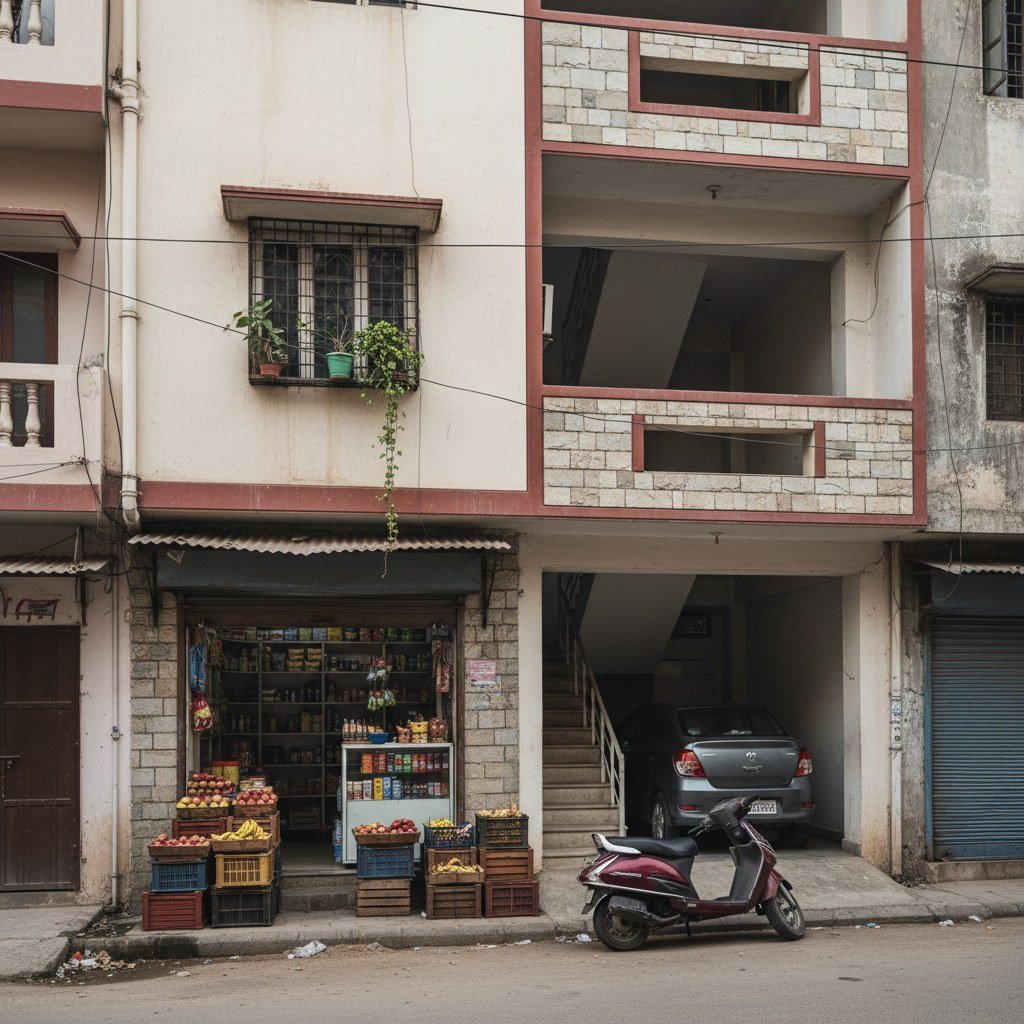
South Delhi vs Noida is usually settled with a rate per square foot. That number is real, and it is also the least useful part of the decision, because the money does not buy the same thing in the two places. In South Delhi the same budget usually buys a builder floor: a whole floor of a low-rise building, with a share of the land beneath it. In Noida it usually buys a flat inside a society, with a lift, a guard and a monthly maintenance bill.
So this comparison is about the parts that never appear in a rate card. What you own. What you pay every month after you move in. Who controls the building. What the commute does to an ordinary working day. And what the seller has to hand over at registry, because that differs by state.

South Delhi vs Noida: what the money actually buys
In South Delhi, a builder floor is a floor plus a proportionate undivided share of the plot. You own the space you live in and a fraction of the land under the building, and the other floors are owned by other people. There is no society, no common fund and no managing committee unless the owners create one. The building is usually four or five floors on a plotted street, and the floors were sold separately.
In Noida, the standard purchase is a flat inside a project: a unit in a tower, on land held collectively through the society or the developer’s lease from the authority. You own your unit and an undivided share in the common areas, but you do not own a piece of ground in the same direct way, and the land’s leasehold or freehold status is part of what you are buying. Ask for the lease deed and whether any conversion has been done, rather than assuming.
That difference is not a technicality. It decides what you can do with the property without asking anyone, what happens when the building needs a new roof, and what a future buyer is actually purchasing from you.
The monthly bill after you move in
A society flat carries a maintenance charge from the day you take possession, whether or not anyone lives there. It covers the lift, the guards, the common lights, the landscaping, the sinking fund and often the club. In newer projects the charge is levied per square foot of your unit, so a larger flat pays more, and it is revised upward by the society when costs rise.
A builder floor has no such bill. What it has instead is a set of direct costs that the owners manage themselves: the pump’s electricity, the staircase lights, the lift’s annual maintenance contract, the water tank cleaning, and the repainting of the shared staircase every few years. Spread across four owners, these are usually smaller than a society charge. But they are not automatic, and someone has to collect them.
The honest trade is this. A society converts money into convenience and predictability. A floor converts it into a lower fixed outflow and more personal responsibility. If you would rather not spend time arranging a pump repair, that preference is worth something and should be part of the comparison.
Who controls the building
On a floor, you control your own four walls and very little else. Changing your kitchen, your flooring or your bathrooms is your decision. Changing the facade, adding a floor above, rebuilding the staircase or putting up a new gate needs the other owners to agree, and they may not.
In a society, the rules are written and the decisions are taken at meetings. That is slower and more impersonal, but it is also predictable: the lift is serviced because the contract exists, not because three neighbours agreed this month. The cost is that you are one vote among many, and the bye-laws can restrict what you do with your own flat.
What you give up when you choose a floor
A builder floor will not give you a clubhouse, a pool, a gym, a landscaped lawn or a reception desk. It will not give you full power backup for every appliance, organised visitor parking, or a single number to call for a plumbing complaint. A large Noida project usually will, and for some households those things are used every week.
What the floor gives in return is space, a private entrance and fewer neighbours. You share a staircase with three households, not a corridor with forty. Your car parks at the building rather than in a basement two levels down. Your drawing room window looks at a street with trees on it, not at the next tower. Whether that is worth more than a club is a household question, not a market one.
Water and power, the two things that decide comfort
In a South Delhi colony, water arrives from the municipal supply into a building tank and is pumped up, with tankers filling the gap in the summer. On a floor, the pressure at the top tap depends on the pump and the tank, and the quality depends on the tank’s condition. These are checkable facts: run the top tap in the morning, look at the tank, ask who pays for the tanker.
Noida’s supply and electricity come through different agencies with different billing cycles and tariffs, and a large project often has its own substation and diesel backup. That is more reliable in ordinary weeks and more expensive in the monthly bill. Neither city is uniformly better. Ask the neighbours in both cases, not the seller.
The commute, tested properly
Distance on a map is not a commute. A South Delhi address and a Noida address can be a few kilometres apart and an hour apart at nine in the morning, because the river crossings carry the traffic of both cities. Test the route at the hour you will actually travel, on a working day, and test it twice: once towards your work and once back.
Then count the other trips. The school run, the parents’ house, the hospital you already use, the market you know, the friends your family sees on a Sunday. A move across the river lengthens all of them, not just the office run, and it changes who is willing to visit you. That is a real cost and no rate per square foot captures it.
The paperwork is not the same in the two states
A Delhi builder floor comes with a chain of title on the plot, a sanctioned plan for the building, the completion and occupancy paperwork, and a mutation record in the buyer’s name after registry. Because there is no society, the seller has to produce the building-level documents themselves, and a buyer’s bank will read them before it sanctions a loan.
A Noida purchase runs on a different set of papers: the allotment letter and lease deed for the land, the builder-buyer agreement, the society’s no-objection certificate, and a clearance of maintenance dues before the transfer is registered. Stamp duty is set by the state, so the rates and the registration office are different from Delhi’s, and the project sits under UP RERA rather than the Delhi authority.
Neither list is harder. They are simply not interchangeable, and a family that has bought in one city often assumes the other works the same way.
How resale works in each
Your floor competes with very few identical homes. There may be no other floor in that block with the same area, the same light and the same condition, so the buyer is comparing it with the locality rather than with its own neighbours. That cuts both ways: a good floor can hold its value, and a floor with a problem has nothing to hide behind.
A flat in a large Noida project competes with the flats in its own tower. Buyers can compare unit numbers, floors and views directly, and the sale price is set against those comparisons. That makes the market liquid and transparent, and it also means your flat is only as saleable as the one two floors below it.
Where a builder floor makes more sense
When the household is anchored in Delhi. Schools, work, parents, the doctor and the friends are on this side of the river, and moving would lengthen three or four journeys a week rather than one. When the family wants a whole floor to itself, with its own entrance, and does not want to manage a club or a committee. When the buyer values the land share and the low-rise street more than the amenity list.
It also makes sense when the buyer intends to stay. A floor rewards the household that will use the space, adjust a kitchen, add a study, and live with the same three neighbours for years.
Where Noida makes more sense
When it is a first home and the amenities are the point: the pool the children will use, the guard at the gate, the backup that keeps the lights on. When work is on that side of the river and the commute actually shortens. When a newer building with a warranty and a facility manager is what the family wants, and the idea of arranging a pump repair is unwelcome.
Four questions that settle it
- Where are the three places your household travels to most weeks? If two of them are in Delhi, the river is the deciding factor, not the property.
- Do you want a club, a pool and a guard more than you want a whole floor and a private entrance?
- Do you want a monthly maintenance bill you do not control, or a set of small shared costs you help manage?
- Can you read the paperwork for the state you are buying in, or will you need help checking whether the seller’s documents are complete?
If the first two answers point to Delhi, the floors we have available in South Delhi are the place to start, and you can request price and availability for any of them. If you are also weighing Gurgaon, the three-city comparison covers the same questions, and the Vasant Kunj floors show what the format looks like in practice.