A property transfer after death in Delhi is usually described as a sequence of paperwork: death certificate, will, mutation. That description works for a flat in a society. It fails for a builder floor, because what the deceased owned was never only a floor. It was the floor plus an undivided share of the plot beneath it, written into the sale deed as a fraction. Both parts pass to the heirs. Both have to end up in the heir’s name. Leave the share out and the heir holds a floor he can live in but cannot comfortably mortgage or resell.
Most families discover this late, when a buyer’s lawyer asks for the chain of documents and finds that the last deed describes a floor while the land underneath is still recorded in the name of someone who died years ago.
What the deceased actually owned
A builder floor is a horizontal slice of a building with a proportionate interest in the land. Four floors on one plot normally means four deeds, each carrying a quarter share, and each floor owner is a co-owner of the plot rather than a tenant of the others. The deed usually records four things: the built portion on that floor, the undivided share in the land, rights over common areas such as the staircase and stilt, and the parking slot allotted.
When the owner dies, all four pass together. If the parent’s deed records a one-fourth share of a plot, the heir’s document should carry the same fraction, in the same description, with the same boundaries. A transfer deed that quietly rewrites the share, or describes only the built floor, creates a defect that surfaces at the next sale. Our explainer on builder floor land share covers how that fraction is calculated and why it matters more than the carpet area.

The three routes, and which one applies
The route depends on one question: did the owner leave a will, and does the family agree on what it says?
| Situation | Route | What it produces |
|---|---|---|
| A registered will exists | Transfer on the strength of the will, then mutation | The named heir’s name in the records, usually without court |
| No will, all heirs agree | Surviving Member Certificate plus a registered relinquishment deed in favour of one heir | A single clean name on the deed |
| No will, heirs disagree | Partition suit before a civil court | Shares decided by the court |
Where a will exists, the executor or beneficiary produces the original will with the death certificate at the sub-registrar’s office. Delhi does not make probate compulsory for a will made by a Hindu, but a sub-registrar, a bank or a housing authority may still ask for probate or letters of administration when the will is unregistered or when another heir objects. An unregistered will is not invalid. It is simply easier to challenge.
Where there is no will, the heirs are decided by the succession law that applies to the deceased. For Hindus, Sikhs, Jains and Buddhists that is the Hindu Succession Act, under which the widow, children and mother take equal shares in the first class. Delhi records this through a Surviving Member Certificate issued by the Sub-Divisional Magistrate, applied for through the e-District portal. If one heir is to hold the floor, the others release their shares through a relinquishment deed, which must be stamped and registered. It is not a family letter, and an unregistered one transfers nothing.
A succession certificate is often confused with all of this. It is a court order that lets the holder collect debts and securities such as bank deposits and shares. It is not a title document for a house, and obtaining one will not transfer the floor.
Where the property transfer after death in Delhi actually happens
Three different offices do three different jobs, and families lose months by treating them as one.
The sub-registrar registers the deed that moves title. For an inherited floor that is usually a transfer deed based on the will, a relinquishment deed, or a partition deed.
The municipal office handles mutation, which changes the name on the property tax record. For a DDA or L&DO property there is a parallel mutation with the authority that allotted the land. Neither is optional if the heir intends to sell, because the next buyer’s lawyer will ask for both the registered deed and the mutation entry.
The SDM office issues the Surviving Member Certificate that establishes who the heirs are, and is the document most Delhi authorities accept when there is no will.
The documents that decide the timeline
- Death certificate from the municipal body where the death was registered, with several certified copies
- The original chain of title: the deceased’s sale deed, and the deeds before it
- The original will, if one exists, and any codicil
- Surviving Member Certificate from the SDM, or probate or letters of administration where the will is disputed
- Relinquishment deed, registered, if the heirs are consolidating into one name
- Family tree affidavit and identity proof for every heir
- Latest property tax receipt and utility bills
- Indemnity bond and no-objection certificates, where the municipal office asks for them
- Two witnesses with identity proof at the sub-registrar’s office
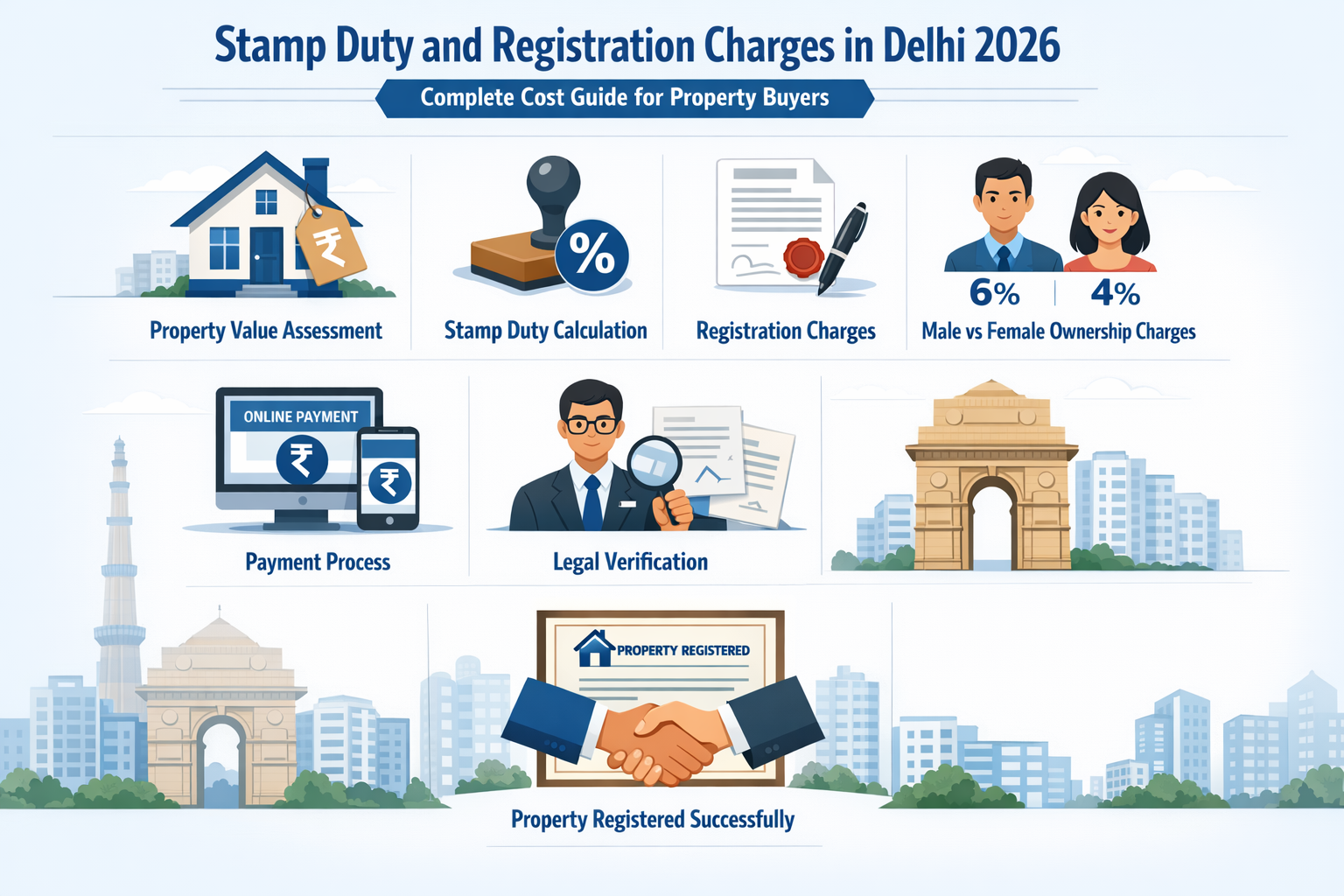
Stamp duty applies to the instrument being registered, and the rate differs between a relinquishment, a gift and a sale. Check the current position on our stamp duty and registration charges in Delhi page rather than relying on an old figure.
Mutation is not title
Mutation is the most misunderstood step. It updates the municipal record for property tax, and for a DDA property it updates the allotment record. It does not create ownership, and it does not cure a defective deed. A mutation entry in the heir’s name, with the title still sitting in the deceased’s name, is exactly the state in which many inherited floors are sold badly or not at all. Our note on mutation after registry in Delhi explains where it sits in the sequence.
If the heirs intend to sell
A floor inherited by four siblings cannot be sold by one of them. Either all four join the sale deed, or three release their shares first so that one holds a clean title. Buyers’ lawyers ask for the full set: the original deed, the death certificate, the Surviving Member Certificate or probate, the relinquishment deeds, the mutation entry and the latest tax receipt.
Two practical points decide how quickly a sale moves. First, the land share must be described correctly, because a bank valuing the floor for a home loan will read the deed and not the brochure. Second, any floor whose title still stands in a dead person’s name will be priced by buyers as a risk, whether or not the family considers it settled.
The mistakes that cost the most
Leaving the floor in the deceased’s name for years. Records age badly. Witnesses die, heirs die, and the proof needed for the next link becomes harder to find with every year that passes.
Writing a will but never registering it. It stays valid, but every authority that reads it will want more.
Transferring the built floor and forgetting the land share. This is the most common builder floor defect we see in older South Delhi papers.
Assuming a nominee becomes the owner. A nomination tells the bank or the society who to deal with. It does not override succession.
Settling shares orally. An informal understanding among siblings holds until one of them needs money.
Two questions families ask most
Is probate compulsory in Delhi?
Not for a will made by a Hindu in Delhi. Probate becomes relevant when the will is unregistered, when an heir disputes it, or when an institution insists on a court order before it acts. Where a dispute is likely, getting probate early is usually cheaper than arguing later.
Does the nominee on the deed become the owner?
No. Nomination is an arrangement for collection, not a transfer of ownership. The heirs under the will or the succession law remain the owners.
What to do in the first two months
- Register the death and collect at least six certified copies of the certificate.
- Find the original title deed and read what it says about the land share.
- Locate the will, and check whether it was registered.
- Apply for the Surviving Member Certificate if there is no will.
- Agree the shares in writing before anyone applies for mutation.
- Register the relinquishment or transfer deed at the correct sub-registrar’s office.
- Apply for mutation with the municipal office, and with the DDA or L&DO where applicable.
- Keep one complete certified set for each heir.
A builder floor transfer is not difficult once the land share, the heirs and the instrument are settled. It becomes difficult when one of the three is left vague, and the vagueness is nearly always discovered by a stranger, at the worst moment, years later.
If your family is sorting out an inherited floor and wants the title, the share and the paperwork examined before you sell or divide, talk to us. We build and sell builder floors in Vasant Kunj, Vasant Enclave and Nangal Dewat, and we know what a clean chain of documents is worth at the point of sale.