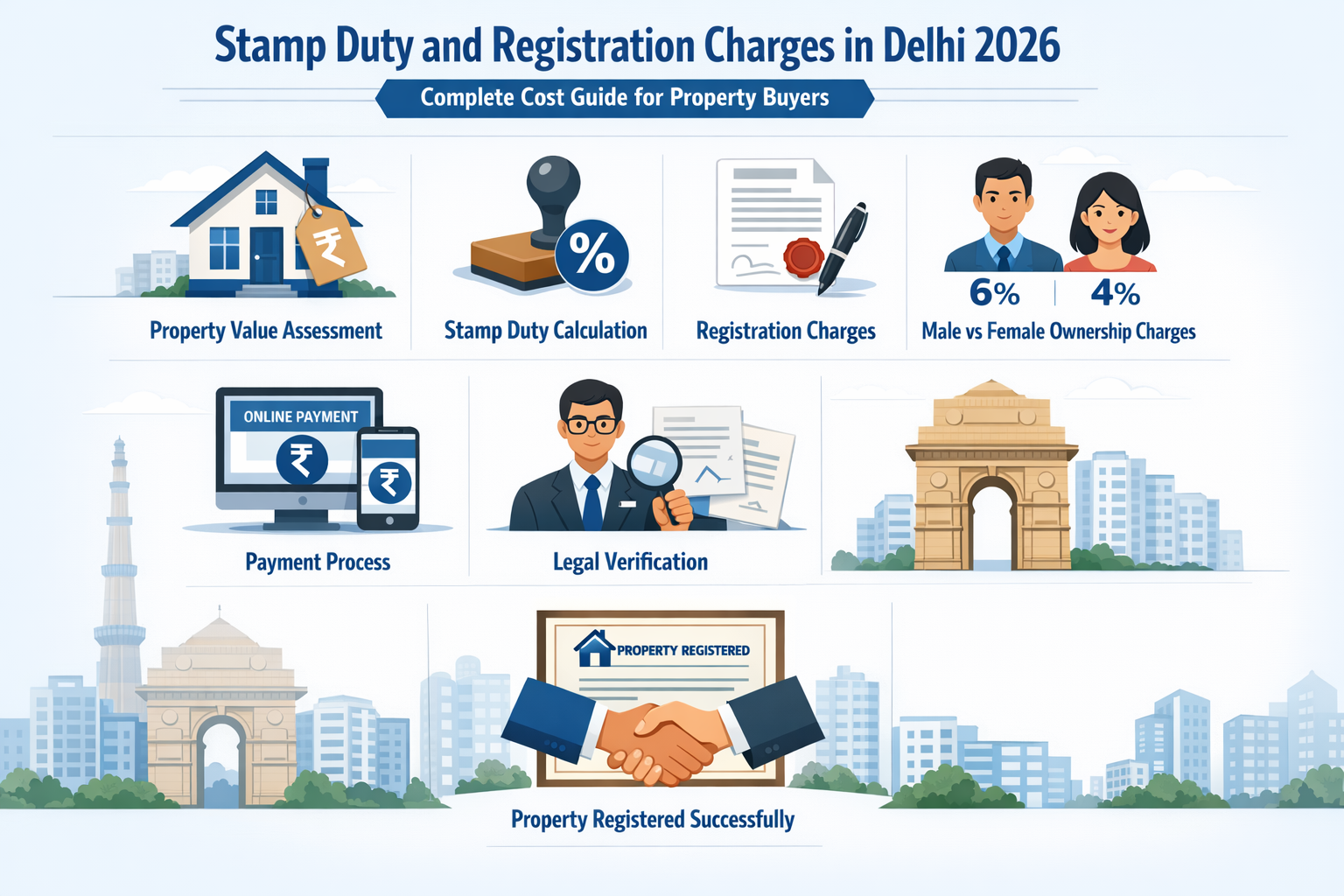
Stamp duty in Delhi is 6% for a male buyer, 4% for a female buyer and 5% for joint ownership — but that is not what you will pay. On any property above ₹25 lakh, which is every builder floor in South Delhi, the Municipal Corporation of Delhi adds a 1% transfer duty, and the registration fee adds another 1%. The all-in government cost is 8% for a male buyer, 6% for a female buyer and 7% for joint ownership.
That 1% is the single most commonly missed line item in Delhi property budgeting. Most online calculators leave it out, because it is a municipal levy and does not appear on the Revenue Department’s stamp-duty rate card. On a ₹4 crore floor it is ₹4 lakh you will be asked for at the sub-registrar’s counter.
Delhi stamp duty and registration charges 2026
Rates for properties above ₹25 lakh in MCD areas — which covers all of South Delhi. The transfer duty applies once the property value crosses ₹25 lakh; the registration fee applies always.
| Buyer | Stamp duty | MCD transfer duty | Registration fee | All-in cost |
|---|---|---|---|---|
| Male | 6% | 1% | 1% | 8% |
| Female | 4% | 1% | 1% | 6% |
| Joint (male + female) | 5% | 1% | 1% | 7% |
A ₹100 pasting charge applies per document on top of this.
The two-slab structure
Below ₹25 lakh, the transfer duty does not apply:
| Buyer | Up to ₹25 lakh | Above ₹25 lakh |
|---|---|---|
| Male | 6% + 1% registration | 6% + 1% transfer + 1% registration |
| Female | 4% + 1% registration | 4% + 1% transfer + 1% registration |
| Joint | 5% + 1% registration | 5% + 1% transfer + 1% registration |
NDMC and Cantonment areas
If the property falls inside the New Delhi Municipal Council area — Lutyens’ Delhi and its immediate surrounds — lower rates apply: 5.5% for a male buyer and 3.5% for a female buyer. Delhi Cantonment properties carry a flat 3%. Almost all of South Delhi sits under MCD, so the standard structure above is what applies to a Greater Kailash, Defence Colony or Saket purchase. Confirm the jurisdiction for your specific address.
What the duty is actually charged on
Duty is charged on the higher of two figures: the transaction value you agreed, or the government’s circle-rate value for that property. You cannot register below the circle rate, and agreeing a price below it does not reduce your bill — the state simply charges on the circle-rate figure instead.
For most South Delhi transactions the market price comfortably exceeds the circle rate, so the deal value governs. The circle rate matters when a property is transferred below market — a family transfer, a gift, or a distressed sale — because then the circle rate becomes the base.
Delhi circle rates by colony category (official minimum rates)
Rupees per square metre, as notified by the Delhi Revenue Department:
| Category | Land, residential | Construction, residential |
|---|---|---|
| A | 7,74,000 | 21,960 |
| B | 2,45,520 | 17,400 |
| C | 1,59,840 | 13,920 |
| D | 1,27,680 | 11,160 |
| E | 70,080 | 9,360 |
| F | 56,640 | 8,220 |
| G | 46,200 | 6,960 |
| H | 23,280 | 3,480 |
Your colony’s category is set by the same A to H classification the MCD uses for property tax, so your tax record confirms it. See the full Delhi circle rate guide for the complete tables and the downloadable PDF.
How a builder floor’s registry value is calculated
This is where a builder floor differs from a flat, and it is the part most guides skip.
A flat in a group housing society is valued using the built-up flat rates. A builder floor is not a flat. The circle rate notification provides that where part of the plinth area — say one floor of an independent property — is sold, the relevant minimum land cost is taken for the proportionate plinth area sold, and the minimum cost of construction is applied to that same plinth area.
So the registry value has two components:
| Component | How it is derived |
|---|---|
| Land | Category land rate × the proportionate share of land attaching to your floor |
| Construction | Category construction rate × plinth area × age factor |
The land share depends on the plot size and how many floors share it — which is why two identical floors in the same colony can carry different registry values. See builder floor land share for how this is apportioned.
The age factor discounts the construction component for older buildings — roughly 0.5 for a structure completed before 1960, rising to 1.0 for one completed from 2000 onwards. A newly built floor therefore carries the full construction value while an older one of the same size is discounted.
Two worked examples
Example 1 — ₹4 crore builder floor in Greater Kailash, registered in the wife’s name.
- Stamp duty at 4% = ₹16,00,000
- MCD transfer duty at 1% = ₹4,00,000
- Registration fee at 1% = ₹4,00,000
- Pasting charge = ₹100
- Total government cost = ₹24,00,100
Registered in the husband’s name instead, stamp duty rises to 6% and the total becomes ₹32,00,100 — an ₹8 lakh difference on identical ownership economics. That is the female-ownership concession working as intended, and it is the single largest legitimate saving available on a Delhi registration.
Example 2 — ₹6 crore floor in Defence Colony, joint ownership.
- Stamp duty at 5% = ₹30,00,000
- MCD transfer duty at 1% = ₹6,00,000
- Registration fee at 1% = ₹6,00,000
- Total government cost = ₹42,00,100
Note that the registration fee is charged on the value, not on the duty — it is 1% of the property value, so on large transactions it is a substantial line item in its own right.
Documents you need at registration
Both parties must be present with original identification, and two witnesses must attend with identification as well. In practical terms, bring:
- Executed sale deed, on e-stamp paper
- PAN card, passport, driving licence or voter ID — both buyer and seller
- Two witnesses with identification documents
- Proof of the e-stamping payment
- Previous title documents and chain of ownership
- No-objection certificate from the society or builder, where applicable
- Latest property tax receipt
- Passport-size photographs
Registration fee above ₹500 must be paid by demand draft or pay order, not cash — a detail that regularly delays registrations on the day.
How payment and registration work
- Pay the duty online through the SHCIL e-stamping portal. You receive an e-stamp certificate, which is the receipt for your payment.
- Execute the sale deed on e-stamp paper, signed by both parties and witnessed.
- Present at the sub-registrar’s office for the district where the property sits, with the documents above. Registration is done through the Delhi Revenue Department’s NGDRS portal.
- Collect the registered deed. The normal turnaround is about 15 days.
Stamp duty, transfer duty and registration fee together are the government’s cost. They are separate from the price you pay the seller, and separate from GST where the property is an under-construction booking.
What happens after registration
Registration transfers title. It does not update the municipal record. You should follow through with mutation of the property in the MCD’s records into your name, because the municipal record is what the MCD uses to raise property tax and to confirm ownership for future transactions or building permissions.
Buyers frequently complete registration and then discover, when they come to sell or seek approval years later, that the municipal record still names the previous owner. It is straightforward to do at the time and considerably more awkward afterwards.
TDS on your purchase: the 1% you deduct from the seller
On any property purchase of Rs 50 lakh or more from a resident seller, you – the buyer – must deduct 1% TDS on the consideration and deposit it against the seller’s PAN. This is your legal obligation, not the seller’s, and it is deducted from the payment you make to the seller rather than added to your cost.
Two things catch buyers out:
- It comes out of the seller’s money, not yours – so it reduces what you hand over, and must be deposited correctly and on time. A wrong or missing PAN, or a deposit after the registration appointment, stalls the registrar’s checklist.
- Purchases from an NRI seller follow a different and much higher TDS regime. If your seller is non-resident, take tax advice before you pay a token amount – the deduction can be a substantial percentage of the whole consideration, not 1%.
Confirm the current threshold and rate with your CA or the Income Tax Department before your payment date.
If the deal falls through: getting your stamp duty back
Duty paid on an e-stamp for a transaction that never completes is not automatically lost. Refund applications go through the Revenue Department – for e-stamps, via SHCIL – and are generally made within six months. Expect a deduction rather than a full refund.
The practical rule that avoids the problem entirely: buy the e-stamp only once the registration date is fixed and the file has cleared legal review. Not at agreement stage, to “save time”. Registration fees paid for an appointment that lapses follow a separate refund route.
Presenting the deed on time
A sale deed should be presented for registration within four months of execution. Beyond that, penalties apply, and past the extended limit the document can require fresh stamping – meaning you pay the duty again on current rates.
The consequence of missing it entirely is worth stating plainly: an unregistered sale document does not transfer title at all. A stamped but unregistered deed protects nobody. If you are buying, the registration is the transaction – not the payment.
Under-declaring value: why it costs far more than it saves
The most expensive stamp duty “saving” on offer is under-declaring the consideration with a cash component to reduce duty. We would not advise it, and not only for legal reasons.
The saving is 6-8% once. The cost is permanent:
- Your registered deed becomes the evidence of your cost base for capital gains – a lower figure means a larger taxable gain when you sell
- It caps your recorded resale value and restricts your loan eligibility against the property
- It creates tax exposure on both sides of the transaction
- A declared consideration below the circle-rate valuation invites referral to the collector for adjudication, which delays registration
Register the true value. Duty on the higher figure is the cheaper outcome.
Registering in a female name: the saving and its cautions
Registering in the name of a wife, mother or daughter at 4% instead of 6% is the single largest legitimate saving available on a Delhi registration. Because transfer duty and the registration fee are flat across genders, the saving is exactly the 2% difference in stamp duty. On a Rs 4 crore floor that is Rs 8 lakh.
Three cautions from practice:
- The named owner genuinely owns the property. That has consequences for succession, for consent to any future sale, and in the event of a dispute. Treat it as an ownership decision, not merely a duty decision.
- If the funds come from the husband while the deed is in the wife’s name, income from the property – rent and capital gains – can be clubbed back to the funder for tax purposes. Structure the funding trail with your CA.
- Joint registration at 5% splits the difference and puts both names on title. It is the most common structure among our buyers, and often the right one where both spouses contribute.
Selling to or buying from an NRI
Where the seller is non-resident, TDS is deducted at a substantially higher rate than 1%, and the buyer carries the obligation. If a power of attorney is being used, the registrar requires the original registered power of attorney – and where it was executed abroad, duly attested. Photocopies are not accepted.
Build extra time into the schedule for these transactions. They are routine, but they are not same-week.
Common mistakes that delay registration
- Budgeting 7% instead of 8%. The missed 1% MCD transfer duty is the most common shortfall. That is roughly ₹4 lakh on a ₹4 crore floor.
- Assuming the price paid is the taxable base. If you buy below circle rate, duty is charged on the circle rate.
- Arriving without two witnesses who have identification with them.
- Using cash for a registration fee above ₹500.
- Missing the property tax receipt. Arrears against the property surface at this point and can stop registration.
- Skipping mutation after the deed is registered.
Frequently asked questions
What is the stamp duty rate in Delhi for a male buyer?
6% of the property value, plus 1% MCD transfer duty on properties above ₹25 lakh and 1% registration fee — an all-in government cost of 8%. Female buyers pay 4% plus the same two charges, giving 6%. Joint male-female ownership is 5% plus the two charges, giving 7%.
Is stamp duty calculated on the circle rate or the deal value?
On whichever is higher. If you agree a price above the circle rate, the deal value governs. If the price is below the circle rate, duty is charged on the circle-rate value.
Can stamp duty be paid after registration?
No. The e-stamp certificate must be obtained, and the duty paid, before the deed is executed and presented for registration.
Does NDMC have lower stamp duty than MCD?
Yes. NDMC areas carry 5.5% for a male buyer and 3.5% for a female buyer, against 6% and 4% in MCD areas. The NDMC concession applies only to properties inside the New Delhi Municipal Council area. Virtual all of South Delhi is MCD.
How much is the registration fee in Delhi?
1% of the property value, plus a ₹100 pasting charge. Amounts above ₹500 must be paid by demand draft or pay order.
Is stamp duty tax-deductible?
Stamp duty and registration charges on a residential property qualify for deduction under Section 80C of the Income Tax Act, within the overall ₹1.5 lakh annual limit.
Who deducts TDS on a property purchase in Delhi?
The buyer. On purchases of Rs 50 lakh or more from a resident seller, the buyer deducts 1% TDS on the consideration and deposits it against the seller’s PAN, before or at the time of payment. It comes out of the seller’s proceeds, not the buyer’s cost.
Can I get a stamp duty refund if the sale does not complete?
Yes, in principle. Refund applications go through the Revenue Department, and for e-stamps via SHCIL, generally within six months of purchase. Refunds are processed with a deduction rather than in full. The safer course is to buy the e-stamp only once the registration date is fixed.
How long do I have to register a sale deed in Delhi?
Four months from execution. Beyond that, penalties apply, and past the extended limit the document may require fresh stamping. An unregistered sale deed does not transfer title.
Is it worth under-declaring the property value to reduce stamp duty?
No. The saving is 6-8% once, but the registered value becomes your cost base for capital gains permanently, caps recorded resale value and loan eligibility, and can trigger referral to the collector for adjudication.
The bottom line
For a South Delhi builder floor in 2026, budget 8% of the value if you are registering in a male name, 7% for joint ownership and 6% in a female name. Check that your figure includes the 1% MCD transfer duty — if a calculator shows you 7% for a male buyer, it has left that line out and you are under-budgeted by 1% of the property value.
If you are working through the numbers on a specific floor, talk to the Rana Infra team — we build and register builder floors in South Delhi and can tell you what the cost will be on your transaction.
Rates reflect those notified as of 2026 and can change by government notification. Confirm the operative rates, the applicable jurisdiction and your colony category at the sub-registrar’s office or on the Delhi Revenue Department portal before your registration date.