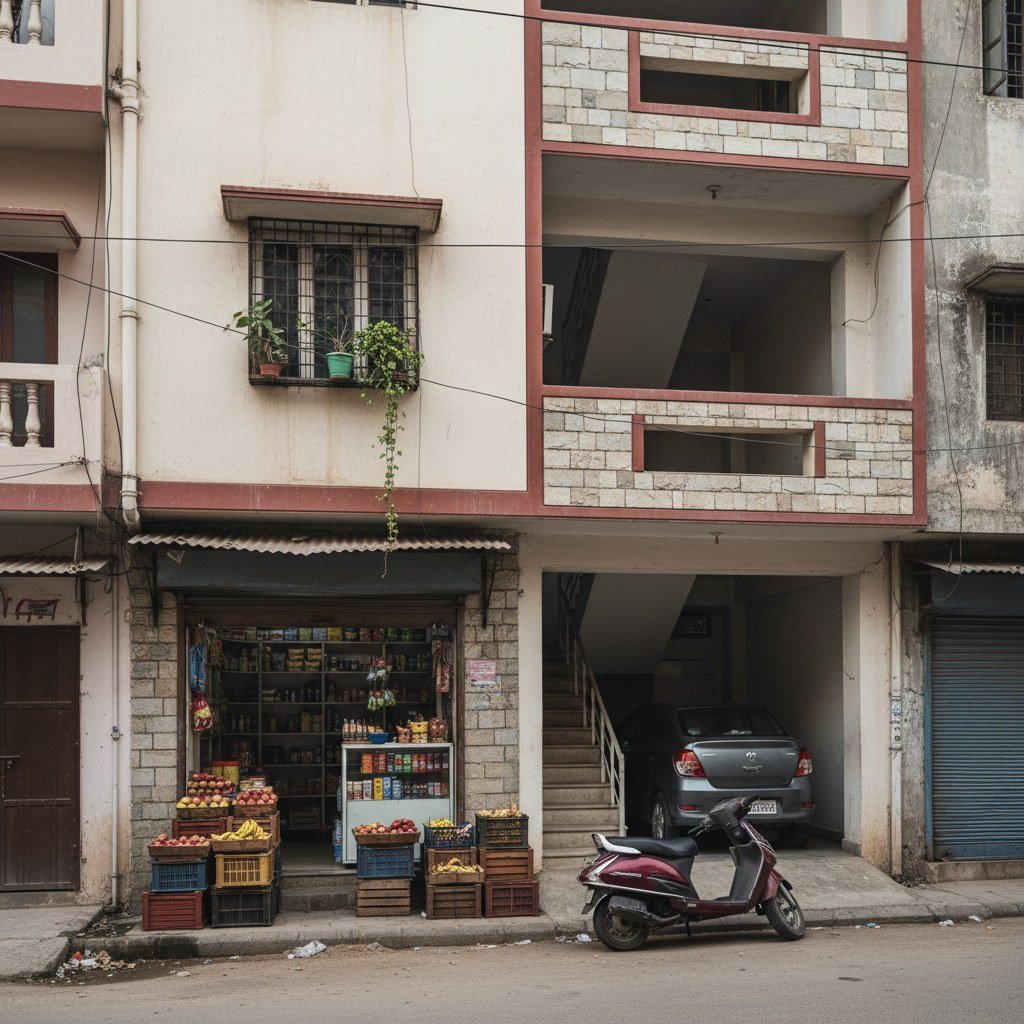

Builder floor monsoon checks are the only inspection a buyer can run that the building cannot fake. In dry weather, a cracked terrace, a blocked outlet and a badly sealed window frame all look much the same as a sound one. In rain they separate within about twenty minutes.
This is what to look at, when to look at it, and what the evidence means, whether you are buying a floor in Vasant Kunj, Nangal Dewat or anywhere else in South Delhi.
Builder floor monsoon checks: three passes through the season
Delhi’s monsoon runs from late June into September. The India Meteorological Department publishes the onset and the seasonal outlook each year; the exact dates move, the sequence does not.
| Window | What you are checking | What it tells you |
|---|---|---|
| Before the rain, May to June | Terrace outlets, parapet coping, sealant lines, window perimeters, sump and pump | Whether the building is ready, and whether anyone maintains it |
| The first heavy spell | Where water stands, where it enters, how fast it leaves | Whether the slopes and the drainage work under load |
| The next 48 hours | Tide marks, damp patches, blistering paint, swollen skirting, sticking doors | What has been leaking for years rather than days |
| October, after the season | New cracks, hollow plaster, rust stains at the slab edge | What the season took out of the structure |
A buyer can use the middle two rows. The first and the last are the owner’s work, and they are the reason the middle two rows look the way they do.
Before the rain: what has to be finished by June
Waterproofing, sealants and crack repairs need dry weather to cure. A terrace membrane laid in humid air, or a joint sealed over a damp surface, will fail in the first proper spell. That is why the work has to be finished four to six weeks before the rain, not started when the first forecast appears.
If you are buying in May or June, the useful question is not whether the terrace was waterproofed but when. A recent treatment with a date, a product name and a bill is worth more than a verbal assurance. Waterproofing tests before possession covers how to run a terrace and bathroom test properly; this post is about what the season itself proves.
On a pre-monsoon visit, look at four things that are awkward to tidy up:
- Where the terrace outlets sit relative to the low point of the slab
- The joints in the parapet coping
- The sealant line around every window frame
- The drain grate at the stilt or in the driveway
Outlets at the high corner, coping with open joints, sealant that has shrunk away from the frame and a grate full of leaves are all small repairs with large consequences.
During the first heavy spell: the half hour that tells you most
Rain does not create leaks. It finds the ones already there, and it does it in the first twenty minutes of heavy fall, before the surfaces have had time to dry.
Arrive while it is still raining if you can, and watch in this order:
- The entrance and the stilt. Water collects at the lowest point of the plot before it goes anywhere else, so a stilt holding an inch of water is telling you about the drain, the slope and the pump in one look.
- The ceiling of the top floor, especially where it meets an external wall and around any pipe passing through the slab.
- The wall under each window, at sill level. This is the most common entry point in a builder floor and the easiest to miss in dry weather.
- The bottom of the main door. If the threshold sits below the level of the landing, water will find it.
- The terrace itself: where it stands, how deep, and whether it is still there an hour later.
- The lift lobby and the floor of the lift pit, where there is a lift. Water in a pit is a maintenance problem with a safety edge.
Photograph what you see with the time on the camera, then photograph the same spot the next day. Two pictures taken a day apart do more work in a conversation than any description.
After the rain: reading the marks it leaves
Most of what matters is visible in the forty-eight hours after a spell, while the surfaces are drying and the water is leaving its record.
- A tide mark is not a stain, it is a level. It shows how high water has reached, and the same line at the same height in two rooms shows it has happened more than once.
- White powder on plaster, or on the underside of a slab, is efflorescence: salts carried through the material by water and left behind when it evaporates. It means water is moving through, not sitting on the surface.
- Paint that blisters in a band rather than a patch usually has moisture behind it rather than above it.
- Skirting that has swollen away from the wall, or a door that has begun to bind, points to moisture at floor level, which is often the plinth rather than the roof.
- A dark patch on a ceiling directly under a bathroom or a terrace is a failed waterproofing layer or a failed joint. Which of the two it is decides whether the repair is small or structural.
- A rust-coloured stain at the edge of a slab or beside a beam is the one mark to take seriously without waiting. It means the steel has lost its cover.
The marks cannot tell you age, depth, or whether the structure has been affected. That needs someone to open the finish and look. Treat them as a reason to investigate, not as a diagnosis.
The parts of the building you do not own
In a builder floor, the terrace, the mumty, the common shaft, the stilt drain and the pump are shared. In most of these buildings there is no society to decide what happens next. Who owns common areas in a builder floor explains how the deed schedule settles that, and why a verbal arrangement is worth very little when a ceiling is dripping.
The practical test for a buyer is simple: ask who repaired the last leak, and who paid. A building where three owners answer that question in the same way has a working arrangement. A building where nobody can answer it has a problem waiting for the next spell. That is not a reason to walk away, but it is a reason to put the arrangement in writing while the seller still wants the sale to complete.
Questions to ask about the last monsoon
- Where did water enter last year, and what was done about it?
- Which repairs were finished before the season, and which were done in a hurry after it?
- Does the terrace drain to the front or the rear, and where does that water leave the plot?
- Has the pump failed during a spell? What happened while it was down?
- Has the lift pit taken water, and who services the lift?
- Who paid for the last shared repair, and how was the split decided?
The answers matter less than the consistency of them. One careful answer, and five that contradict it, is information.
Repairs that should wait, and repairs that should not
Some work should not be started in the rain: terrace waterproofing without a plan for where the water goes, external painting in humid weather, and any sealant that needs a dry surface. Doing them during the monsoon is how a repair becomes a repeat.
What should not wait is anything letting water into the structure: an open joint at a parapet, a cracked coping, a downpipe that has come away. A temporary cover, photographed, with a note of what was done and when, is better than leaving it until October. Where the building has a basement or a stilt that floods, stilt parking flood risk covers the levels, the pump and the overflow route in more detail.
What the rain is worth to a buyer
A monsoon visit is not a formality before the real inspection. It is the inspection. Everything a seller tells you about drainage, waterproofing and repairs is a claim, and this is the one season when the building answers on its own.
If a floor passes in the rain, the dry-weather checks become routine: the inspection checklist for a second visit covers those. If it does not, you have found the conversation worth having before any money moves.
Questions buyers ask about monsoon checks
Is the monsoon a bad time to buy a builder floor?
No. It is the best time to inspect one. Two things are genuinely slower: exterior repair work, because it needs dry weather to cure, and any step that depends on a dry site. The paperwork is unaffected.
What if it does not rain during my visit?
Ask for a second visit during a spell, or for dated photographs of the terrace, the ceilings and the window walls from the last season. Then read the marks as described above. A dry visit in September can still show you what July did.
Does a damp patch always mean a structural problem?
No. Most damp in a builder floor comes from a joint, a waterproofing layer or a plumbing leak, and most of those can be repaired without touching the structure. The exceptions are the ones to take seriously: a rust stain at the steel, a crack that widens, or a ceiling that sags.
Is it worth waterproofing just before the monsoon?
Yes, if it is finished early enough to cure. Late May is usually the last sensible window in Delhi. Work done in the first weeks of the rain is often a temporary fix that has to be redone.
If you are comparing floors in this part of South Delhi, the South Delhi builder floors page sets out what is available, and you can request price and availability for a specific floor and ask what the building did in the last monsoon.
Rana Infra is currently building at Nangal Dewat — Samriddhi, D-58, Nayab, D-71 and Sukoon, D-50. See what is available.