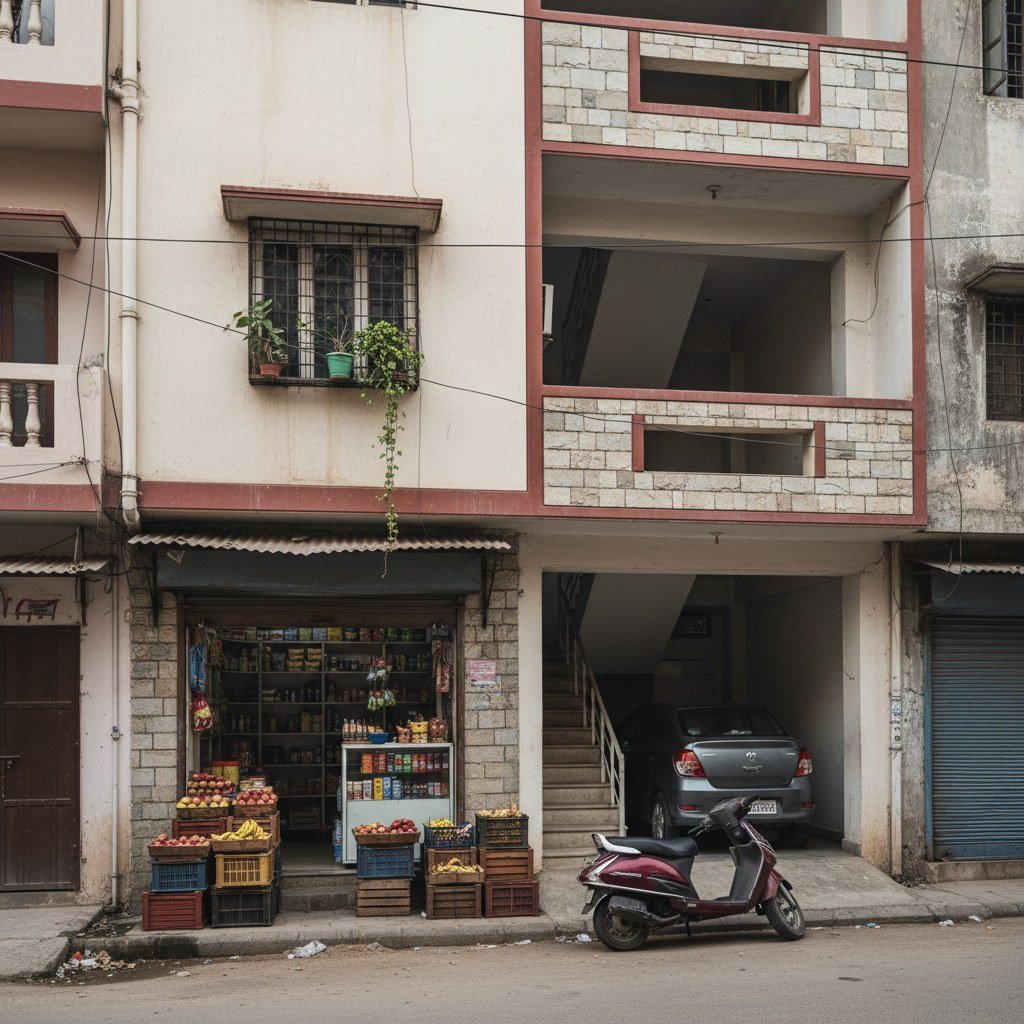

Who owns common areas in a builder floor is the question that decides what you can actually do with the home you buy: whether you can put a lock on the terrace door, whether anyone can stop you using the lift, and who pays when the pump burns out. In a Delhi builder floor the answer is rarely “the society”, because most of these buildings do not have one.
This is a short guide to what is shared, what is not, and where to find the answer in the documents before you pay anything.

The short answer: the sale deeds decide
A builder floor is not an apartment under a housing statute. It is one floor of a building carved out of a single freehold plot, usually through a collaboration agreement between the landowner and the builder, and then sold floor by floor. Each buyer gets the floor, a proportionate undivided share of the land beneath it, and whatever rights in the shared parts the deed names.
So there is no statutory list of common areas and no residents’ association waiting to be formed. A handful of private conveyances sit on one plot, and the schedule of each deed says what travels with that floor.
If the schedule does not name it, you do not own it, however long you or the previous owner have been using it.
Who owns common areas in a builder floor: what is always shared
Some parts cannot sensibly belong to one floor, because taking them would make the other floors unusable:
- The staircase, its landings and the entrance gate
- The lift, its shaft and its machine room, where a lift is fitted
- The underground sump, the pump and the overhead tank
- The mumty, the small enclosed room on the roof that gives access to the tank
- The meter room and the electrical shaft
- The boundary wall, the strip of ground around the building and the drainage line
A shared area in a small building is less a legal category than a practical one. It is the part that no single floor can take away from the others.
What is usually reserved to one floor, and why it feels shared
| Part of the building | Usual position in a Delhi builder floor | What to check in the papers |
|---|---|---|
| Roof and terrace | Carried by the top floor, with access kept for tanks and repairs | That the schedule names the roof, and that the other floors have a written right to reach the tank |
| Stilt parking | The stilt is shared; a marked bay is allotted to each floor | A bay number, not “one car parking” |
| Basement | Usually sold with the ground floor as one unit | The sanctioned use; Delhi bye-laws restrict what a basement may be used for |
| Front setback and lawn | Usually enjoyed by the ground floor | Whether the strip is inside the boundary of what you are buying |
| Water tank space | Shared, even where the roof is not | How the top-floor owner gets access without asking permission each time |
Why “proportionate rights in common areas” is not enough
That phrase appears in almost every builder floor deed, and on its own it conveys very little. It is a promise that you have rights, without saying which.
Ask for the schedule of the property, the part of the deed that lists exactly what the floor includes. Read the list. Then ask what is missing from it.
Two things are worth checking while you have the papers open:
- The land shares on the deeds should agree with each other and add up. If one floor carries a materially different share from the others, ask why, and get the answer before you book.
- The mumty is the classic test case. It sits on the roof, so does it belong to the top floor? If the tank is inside it and every other floor needs water, every other floor needs a written right to reach it.
Who pays for repairs when there is no association
Without a society there is no maintenance levy, no sinking fund and no statutory process for an owner who refuses to pay. Repairs are a private arrangement between the owners in the building.
Two bases are common: an equal split per floor, or a split by land share. Both are used in South Delhi, and neither is wrong. What matters is that one of them is written down somewhere before the first lift repair. The maintenance fund arrangement that owners actually follow is worth reading before you buy into a building shared with three strangers.
The lift is where this usually breaks. The ground-floor owner does not use it much. The top-floor owner depends on it. The motor fails in July, and four people who have never discussed money have to agree on a bill in a week.
The roof is the part buyers get wrong most often
“The top floor gets the terrace” is market practice, not law. Two variations turn up often in South Delhi: older deeds that say nothing about the roof at all, and buildings where the landowner kept the roof when the floors were sold.
Even where the roof is carried by the top floor, the tank, the access to it and any lift machine room on the slab are not part of what you can close off.
What you can do with a roof you carry: sit on it, waterproof it, keep a tank on it, add shade subject to sanction. What you cannot do: build a room without sanction, lock the other owners away from the tank, or sell the roof separately from the floor. The basement rules in Delhi follow the same logic. What the plan allows is the limit, not what the last owner got away with.
Can one owner sell or mortgage a shared part?
No. Shared parts travel with the floor. A parking bay can be allotted to a floor, but it is not parcelled off as separate property.
If a seller offers extra terrace or extra parking as a separate item, ask where it appears in the schedule. If it is not there, you are being offered use, not title.
How to check this at a visit
- Count the floors and ask how many separate sale deeds exist for the building.
- Ask to see the schedule for the floor you are buying, not just the first page of the deed.
- Ask which floor’s documents name the roof.
- Ask where the water tank is and who holds the key to the mumty.
- Ask for your parking bay number and look at the marked bay.
- Ask who services the lift and on what arrangement.
- Ask what happens when an owner does not pay for a repair.
None of these questions needs a lawyer. They need a seller willing to open the file.
Where our own buildings sit
We build on single plots and sell floors, not shares in a company, so the shared parts in our buildings are not sold off as a separate product. When you ask about a floor at Sukoon, Nayab or Samriddhi, ask which documents come with it and what they name. That question should be answered before any money moves, by any seller in South Delhi, including us.
If you are comparing buildings, the South Delhi builder floors page sets out what is available, and you can request price and availability for a specific floor.
Questions buyers ask about common areas
Who owns the staircase in a builder floor?
All the floors share it. It is the one part that cannot be enclosed, locked or converted, because every floor above the ground depends on it for access and for a second way out.
Who owns the lift, if it opens only into my floor?
The lift and its shaft are shared even where the car opens directly into one residence. What you have is the use of it, and a share of the cost of running and repairing it.
Is the roof always the top floor’s?
No. It is the top floor’s where the documents say so, which is usual practice but not a rule. Where the deed is silent, the roof is best treated as shared until a lawyer has read the chain of documents.
Does RERA settle this?
Most single-plot builder floors fall below the thresholds at which Delhi RERA registration is required, so there is no regulator-made list of common areas to appeal to. Where a project is registered, the Act’s definition of common areas applies, and the Delhi RERA portal lets you check whether a project is on the register.
What if there is no written arrangement for repairs?
Then you are relying on neighbours. It is worth asking for one in writing at the time of purchase, while the seller still wants the sale to complete.
Rana Infra is currently building at Nangal Dewat — Samriddhi, D-58, Nayab, D-71 and Sukoon, D-50. See what is available.