
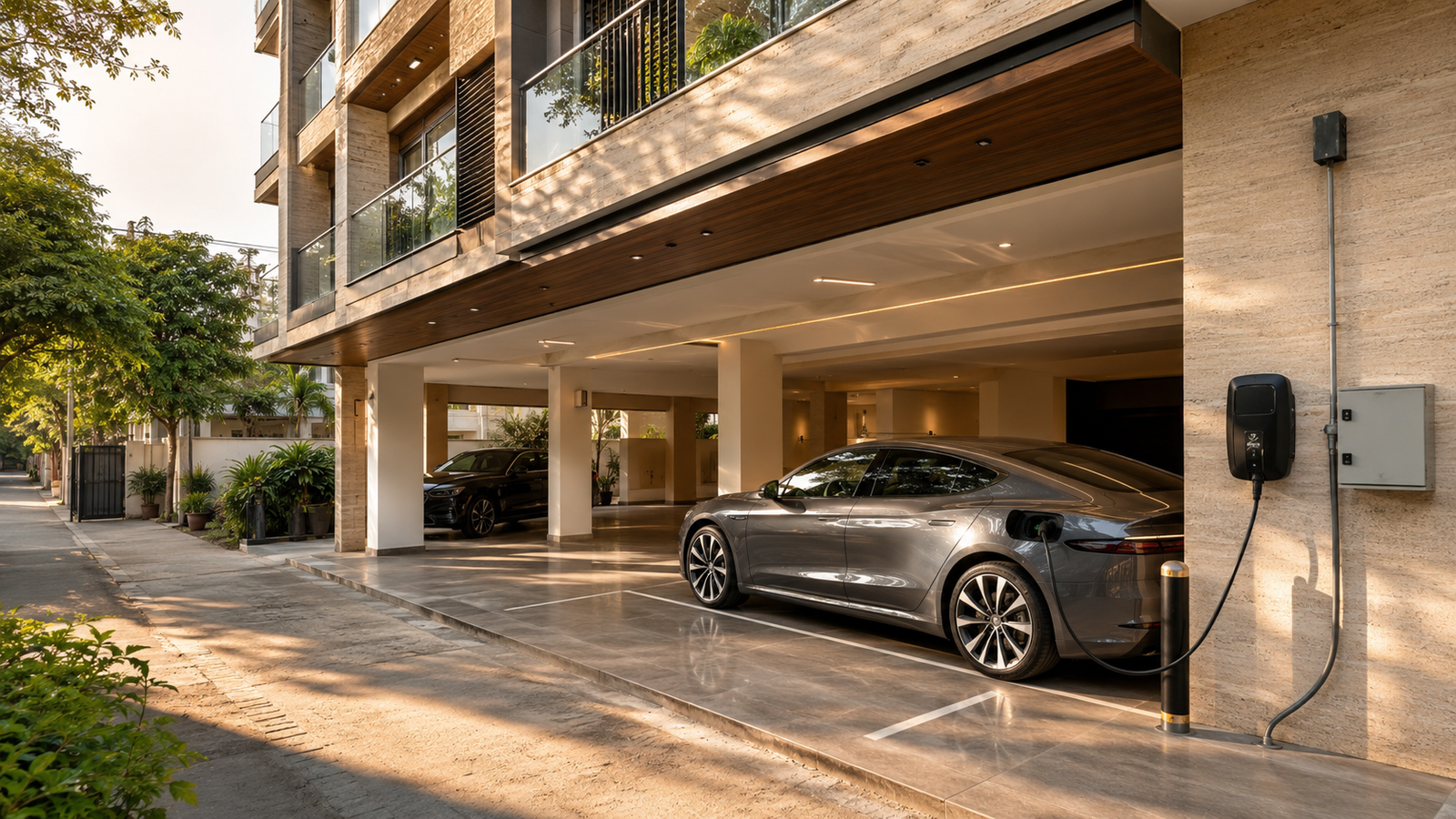
An EV charging builder floor Delhi setup is becoming an important consideration for homebuyers who own an electric car or expect to purchase one in the future. However, a socket near the parking bay does not automatically make a property EV-ready.
Safe electric vehicle charging requires adequate electrical load, a dedicated circuit, suitable wiring, proper earthing, protective devices and a clearly defined parking space. Buyers should also check who will pay for the electricity, whether cables cross common areas and whether a second charging point can be installed later.
Before buying one of the available builder floors in South Delhi, inspect the EV charging provision as carefully as the lift, power backup, plumbing and parking layout.
Why EV Charging Matters in a Delhi Builder Floor
Most electric-car owners prefer charging at home because the vehicle remains parked for several hours overnight. A properly designed home charger can make EV ownership convenient without requiring frequent visits to a public charging station.
The challenge in a builder floor is that the parking level is normally shared by several floor owners. The electrical meter, cable route, parking allocation and common-area responsibilities must therefore be planned carefully.
An EV charging builder floor Delhi buyer should determine:
- Whether the parking bay is exclusively allocated
- Whether a dedicated charging cable has been installed
- Which electricity meter will record consumption
- Whether the building has sufficient sanctioned load
- Whether the charger has appropriate electrical protection
- Whether the installation has proper earthing
- Whether another resident’s charger can be added later
- Whether the cable crosses a driveway or common passage
- Whether the charger is protected from water and vehicle impact
These checks are especially relevant for larger 4 BHK builder floors in South Delhi, where families may own two or more vehicles and require future charging capacity.
EV Charging Builder Floor Delhi: Is a Normal Socket Enough?
A normal domestic socket may support limited charging for certain vehicles when permitted by the vehicle manufacturer. However, buyers should not assume that every socket is suitable for regular EV charging.
Electric vehicles can draw power continuously for several hours. Loose connections, undersized wires, poor-quality sockets or overloaded circuits can create heating and safety risks.
A permanent EV charging setup should generally be planned around:
- The vehicle manufacturer’s charging specification
- The charger’s rated power
- A dedicated electrical circuit
- Appropriately sized cables
- A dedicated protective device
- Effective earthing
- Safe cable routing
- Suitable enclosure protection
- Professional testing and commissioning
The Central Electricity Authority maintains safety regulations and standards relating to electric vehicle charging installations. It states that charging equipment should be installed and operated according to the applicable electrical-safety provisions and relevant standards.
Buyers should use the charger recommended or approved by the vehicle manufacturer and have it installed by a qualified professional.
Check the Building’s Sanctioned Electrical Load
The first technical question is whether the property has adequate electrical capacity.
Ask the seller or builder for:
- The building’s sanctioned electrical load
- Floor-wise load allocation
- Common-area electrical load
- Lift and water-pump requirements
- Air-conditioning load assumptions
- Power-backup capacity
- Existing EV charging load
- Provision for future chargers
A premium builder floor may already require significant power for air conditioning, lifts, pumps, kitchens, home automation and other equipment. Installing an EV charger without reviewing the total demand can lead to frequent tripping or an overloaded electrical system.
The charger capacity should be selected only after a qualified electrical professional assesses the available load, wiring and distribution arrangement.
An EV charging builder floor Delhi installation should not be connected casually to a common-lighting circuit or an unidentified socket in the stilt area.
Demand a Dedicated EV Charging Circuit
A dedicated circuit means that the charger has a separate electrical route from the distribution board instead of sharing a circuit with lights, pumps, guard rooms or common sockets.
A properly planned circuit should include:
- Cable sized according to the charger load and cable length
- A clearly labelled circuit
- Dedicated isolation
- Suitable overcurrent protection
- Earth-leakage protection compatible with the equipment
- Reliable earthing
- Safe termination
- Accessible emergency shut-off
- Testing before use
The exact protection equipment depends on the charger and manufacturer’s requirements. Buyers should avoid specifying components without consulting a licensed electrician or electrical engineer.
A dedicated circuit also simplifies maintenance. If a fault develops in the charger, it can be isolated without switching off the complete stilt parking area.
Verify the Electricity Meter and Billing Method
Electricity billing can become a source of disagreement between floor owners.
Before purchase, determine whether the charger will be connected to:
- Your individual floor meter
- A dedicated EV meter
- The common-area meter
- A sub-meter connected to another supply
The simplest arrangement is usually one where the owner’s charging consumption can be measured separately and transparently.
Ask these questions:
- Who will receive the charging bill?
- Is charging connected to my floor meter?
- Will the common-area association collect payment?
- Is there a sub-meter?
- Who owns the charging equipment?
- Who pays for repairs?
- Can another owner use the charger?
- How will future tariff changes be handled?
Do not accept an unclear promise that electricity expenses will be “adjusted later.” The arrangement should be understood before possession and preferably recorded in the floor-owner or maintenance agreement.
Check the Cable Route From Meter to Parking
The distance between the electricity meter and parking bay affects installation complexity.
Inspect whether:
- A dedicated conduit already reaches the parking bay
- The route passes through common spaces
- The cable crosses a driveway
- The installation requires surface-mounted wiring
- The cable is protected against impact
- Other owners must approve the cable route
- Space exists for future additional wiring
- Maintenance access remains available
Loose cables should never run across a driveway or pedestrian route. Cables should be properly enclosed, mechanically protected and installed without obstructing parking or access.
In an EV charging builder floor Delhi project, planning conduits during construction is far better than cutting completed walls, ceilings and stilt finishes after possession.
Inspect Earthing and Electrical Protection
Earthing is a critical component of EV charger safety. Buyers should ask the electrical contractor to demonstrate that the charger is connected to an effective earthing system.
The inspection should cover:
- Earthing arrangement
- Continuity of the protective conductor
- Condition of the distribution board
- Quality of terminations
- Isolation device
- Protection against earth leakage
- Protection against short circuits and overload
- Labelling of the EV circuit
- Test results after installation
The Central Electricity Authority’s EV charging resources include safety regulations and Indian standards for conductive AC and DC charging systems. These standards are intended to address safe installation and operation under Indian conditions.
Do not approve a charger solely because it powers on. Electrical testing and proper commissioning are necessary.
Choose a Safe Charger Location
The charger should be accessible without becoming vulnerable to vehicles, water or misuse.
A suitable charger location should:
- Be close to the allocated parking bay
- Avoid vehicle turning paths
- Remain protected from impact
- Avoid low-lying waterlogging zones
- Provide adequate cable reach
- Avoid creating a tripping hazard
- Be reasonably ventilated
- Allow safe isolation
- Remain accessible for maintenance
- Avoid blocking fire or service access
Where necessary, a protective barrier or bollard can reduce the risk of a vehicle striking the charger.
The charger enclosure should also be suitable for the installation environment. Stilt parking may be partially open and exposed to dust, rainwater, humidity or accidental washing.
Is the Parking Space Legally and Practically Usable?
An EV charger is useful only when the buyer has reliable access to the corresponding parking bay.
Check whether:
- The parking space is mentioned in the sale deed
- The bay is exclusive or common
- It is independent or tandem
- Another vehicle can block access
- The charger cable can reach the charging port
- The bay can accommodate a larger future vehicle
- Structural columns restrict door opening
- The driveway has adequate turning space
- The parking allocation may change later
Buyers evaluating luxury builder floors in South Delhi should physically park the vehicle in the proposed bay instead of relying only on a drawing.
Charging-port positions vary between vehicles. A charger placed correctly for one model may be inconvenient for another if cable length and parking direction are not considered.
Can the Power Backup Charge an Electric Car?
Do not assume that the building’s generator or power-backup system supports EV charging.
Most backup systems are prioritised for essential requirements such as:
- Lift operation
- Water pumps
- Common-area lighting
- Security equipment
- Selected household circuits
EV charging may place a substantial additional load on the backup system. In many cases, it may be unnecessary or impractical to charge an electric car during a power cut.
Ask the builder:
- Is the EV circuit connected to backup power?
- Is the backup system sized for charging?
- Will charging automatically stop during an outage?
- Could EV charging affect lift or pump operation?
- Is load prioritisation installed?
The answer should be based on electrical design rather than a verbal assurance.
Plan for Two EVs and Future Charging Requirements
A buyer may own one electric vehicle today but require two charging points later.
Future-ready planning can include:
- Spare electrical capacity
- Additional conduits
- Space inside the distribution board
- Expandable cable routes
- Multiple parking-bay access
- Load-management capability
- Separate metering options
- Space for upgraded charging equipment
Installing spare conduits during construction is usually simpler than modifying a completed building later.
A well-planned redeveloped builder floor in South Delhi should consider the future electrical requirements of all floor owners, not just the first EV purchased in the building.
EV Charging in Shared Builder-Floor Parking
Shared parking requires written operational clarity.
The floor-owner agreement should ideally address:
- Ownership of charging equipment
- Permission to install new chargers
- Approved cable routes
- Use of common walls and columns
- Electricity billing
- Repair responsibility
- Damage to common areas
- Charger relocation
- Access for maintenance
- Rules for visitors
- Expansion for additional EV owners
Without a written process, future owners may disagree about drilling, cable placement, metering or the use of shared electrical infrastructure.
Delhi’s EV programme has promoted private and semi-public charging infrastructure, including a single-window process for charger installations at eligible premises. Buyers should verify the current process and applicable DISCOM requirements at the time of installation.
EV Charging Builder Floor Delhi Buyer Checklist
Before paying a token amount, check:
- Dedicated parking allocation
- Charger location
- Sanctioned electrical load
- Charger power requirement
- Dedicated circuit
- Cable size and route
- Earthing system
- Electrical protection
- Individual or sub-metering
- Water and impact protection
- Manufacturer-approved equipment
- Installation documentation
- Testing and commissioning report
- Maintenance responsibility
- Future second-charger provision
- Generator connection status
- Written floor-owner rules
Ask a qualified electrical professional to inspect the system when technical information is incomplete.
Common Red Flags
Be cautious when:
- The charger is connected through an extension board
- A normal socket is described as a complete EV solution
- The cable crosses the driveway
- Charging uses the common meter without sub-metering
- The builder cannot confirm available electrical load
- No dedicated circuit is provided
- Earthing has not been tested
- The charger is installed in a waterlogging area
- Parking allocation is not documented
- The charger obstructs another owner’s space
- No one accepts responsibility for maintenance
A decorative “EV charging point” label does not prove that the installation is safe or usable.
Rana Infra Site Note
For an EV charging builder floor Delhi property, the best time to plan charging is before the stilt ceiling, electrical shafts and distribution boards are completed.
Rana Infra recommends coordinating the parking layout, cable conduit, meter position, earthing and charger location as one integrated design decision. This produces a cleaner installation and reduces the need to cut finished surfaces after handover.
Explore current Rana Infra builder-floor projects to understand how parking, planning and modern residential requirements can be evaluated together.
Conclusion
A practical EV charging builder floor Delhi setup requires more than a socket in the stilt parking area. Buyers should verify the building’s electrical capacity, dedicated circuit, cable route, meter connection, earthing, protective devices and parking rights.
They should also determine who pays for electricity, whether backup power supports charging and whether the building can accommodate additional EVs later.
Before purchasing, ask a qualified professional to inspect the electrical installation and confirm compatibility with the selected vehicle and charger. Good planning improves convenience, safety and the long-term usability of the builder floor.