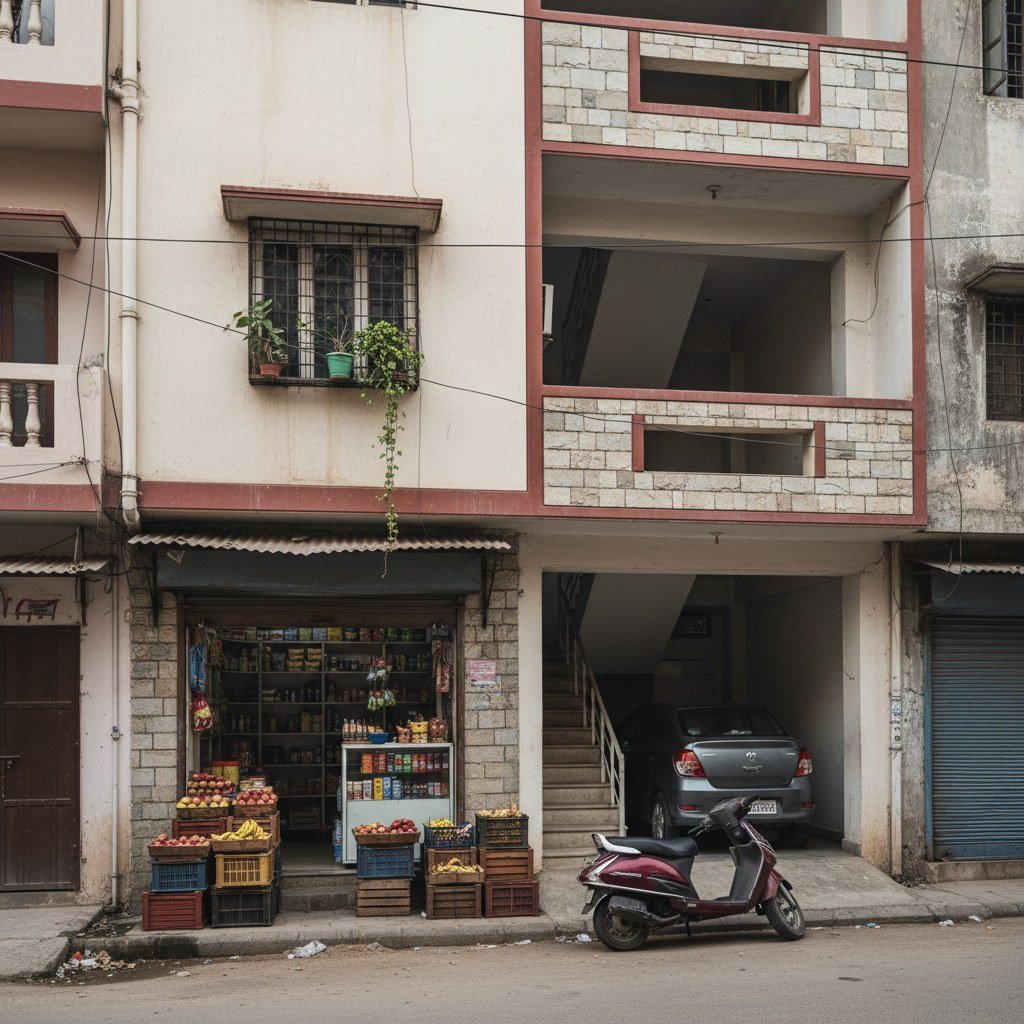

Partition of property in Delhi rarely ends with a plot divided by a boundary wall. In the colonies where a family owns one house and little else, the division happens by floor. One heir takes the ground floor, another the first, a third the second, and the staircase stays shared. Everyone signs, the deed is registered, and each household lives on its own level.
That is also how most such floors reach the market. A buyer ten or fifteen years later is not dealing with the family that built the house. He is dealing with an heir who received a floor in a settlement, and the file begins with a sale deed in somebody else’s grandfather’s name.
This is what a partition in Delhi actually produces, what the deed has to say, and what a buyer of one floor inherits along with it.
Partition of property in Delhi: what the deed actually does
A partition does not create a new property. It converts joint ownership into separate ownership. Before it, four people own a house together, each with an undefined share in the whole. After it, each owns a defined portion outright, and can sell it, mortgage it, rent it or leave it to his own children without asking the others.
For that to be effective against anyone other than the family, the instrument has to be stamped and registered at the sub-registrar’s office that has jurisdiction over the property, through an appointment on the Delhi registration system. A partition recorded only in a notarised document has not moved title. It has recorded an intention.
The other thing a partition does is fix the share in the land. On a builder floor, the floor is the visible asset and the undivided share of the plot is the one that holds value. A partition that allots floors without stating each sharer’s share in the plot leaves the most important part of the ownership undefined.
When the shares are floors and not parcels
A Delhi house on a plotted colony is divided vertically for practical reasons: a plot is wide enough for four families to live above one another and too narrow to be cut into four usable strips with four separate entrances.
Three documents decide whether that division works. The first is the parent deed, which says what the family originally owned. The second is the partition deed, whose schedule must describe each share by floor level, dimensions and boundaries, not merely by the words “second floor”. The third is the sanctioned building plan, because a floor is only a lawful separate dwelling if the plan allows it.
That third document is where most floor buyers get caught. A partition can allot a floor that was built beyond the sanctioned plan, or a fourth floor where the plan permits three. The deed looks correct, the mutation may even go through, and the floor remains what it always was: unauthorised construction. Our note on checking unauthorised construction sets out how the MCD record is read.
Four ways a Delhi family divides a house
| Route | What it is | What a later buyer gets |
|---|---|---|
| Registered partition deed | Every co-owner joins, shares are defined, the deed is stamped and registered | The cleanest title: the deed sits in the chain and each share can be sold or mortgaged alone |
| Registered family settlement | An arrangement wider than a strict partition, often used where several properties are swapped between branches | Good title, provided every person with a claim is a party and it is registered |
| Family settlement on stamp paper, unregistered | A record of what the family agreed, frequently drafted by a local advocate and notarised | No registered transfer. Municipal records usually still show the old joint holding |
| Court decree | A preliminary decree fixes the shares; a final decree divides the property by metes and bounds | The decree plus the Local Commissioner’s plan does the work of a schedule |
The last route is slow but it produces the most complete record, because a court-appointed commissioner visits the property, measures the portions and reports a scheme of division. Where the portions cannot be equalised in area, the court adjusts the difference by a payment from one sharer to another. That payment then has to appear in the decree, and a buyer reading only the deed will not see it.
Who counts as an heir, and why the word ancestral misleads
Families describe any house that has been in the family for two generations as ancestral. The law is narrower, and the difference decides who has to sign.
Where a Hindu owner dies without a will, his property passes under section 8 of the Hindu Succession Act, 1956 to his Class I heirs, who take equal shares: widow, sons, daughters and mother, with the children of a predeceased child taking that child’s share. Property received that way is the heir’s own property. The Supreme Court held in Commissioner of Wealth Tax v. Chander Sen (1986) that a son who inherits from his father under section 8 takes it as his individual property, and in Uttam v. Saubhag Singh (2016) that the coparcenary does not continue through succession. The Delhi High Court has applied both consistently, including in a 2025 decision where it rejected a granddaughter’s suit over a Janakpuri house her grandfather had bought in the 1970s, because her father was alive and she had no share while he was.
Two consequences for a buyer. First, a partition among the children of the last owner is normally a division among co-owners, not coparcenary property, and every co-owner has to sign. Second, since the 2005 amendment to section 6, a daughter is a coparcener in her own right in joint family property, with the same share as a son. A partition that quietly leaves a daughter out is the most common defect in Delhi family files, and it is the one that surfaces years later, when someone sells the floor you bought.
Where a share belongs to a minor, a parent cannot simply sell it. Alienation of a minor’s interest needs the permission of the District Court, and a sale without it can be challenged when the child turns adult. Our guide to property in a minor’s name covers what a buyer should ask for.
What the deed has to describe
Read the schedule, not the preamble. It should carry, for each share:
- The floor, by level, with dimensions and the four boundaries.
- The share in the plot, expressed as a fraction or a specific area.
- The parking bay, by number or position, and whether it is covered.
- The terrace, the mumty and the water tank platform, and who holds the rights to each.
- The staircase and the right of passage over it, stated for every share rather than assumed.
- The service shafts, the meter room and where the connections sit.
- Any payment made by one sharer to another to equalise unequal portions.
If a line is missing, it is missing for everyone who buys afterwards.
What stays behind when the floor is sold
A buyer of one floor of a partitioned house gets less than the building he can see.
The parent deed stays in the chain. Your title rests on the original sale deed, the death certificate of the last owner, the partition deed and the mutation. A seller who offers only the partition deed is offering the middle of the story.
The land share is a share, not a strip. You own a proportionate undivided interest in the plot with the other floor owners. You cannot fence it, and you cannot sell it separately from the floor.
Rights reserved to another share do not travel. If the partition gave the terrace to the top floor, the second floor has no terrace rights however convenient the parapet looks. If it gave bay number two to the ground floor, that bay is not yours.
Shared arrangements are informal. Cleaning, lift maintenance and water pumping run on an understanding between households, not on a society’s bye-laws. Nothing in the deed enforces them, and you inherit the arrangement as it stands.

- The parent sale deed, and the chain back from it.
- The death certificate of every owner whose succession created the shares.
- The registered partition deed, with the schedule and site plan attached to it.
- The sanctioned building plan, to confirm the floor being sold is on it.
- The MCD mutation record for that share, and the property tax receipts against it.
- The electricity and water connection papers in the name of the sharer who is selling.
- The share of the plot, checked against the total area in the parent deed.
- Where a minor holds a share, the court order permitting the sale.
After the division: mutation, tax and connections
Registration is not the end of the paperwork. Under section 128 of the Delhi Municipal Corporation Act, 1957, notice of the transfer has to reach the corporation, and each sharer then applies for mutation in the property tax record. In Delhi that application runs through the MCD’s online system against the property’s identification code, with the partition deed as the basis. Our explanation of mutation after registry covers the sequence and the documents.
Mutation is a fiscal record, not proof of title. The Supreme Court has said so repeatedly, and the practical meaning for a buyer is simple: a record in the seller’s name is supporting evidence, and the registered deeds are the title. What mutation does give you is a name on the tax record and a basis for separate electricity and water connections, which each floor needs in its own right.
The question that settles it
Before you shortlist one floor out of a divided house, ask the seller for the whole file at once: parent deed, partition deed with its schedule, sanctioned plan and mutation. A seller who can produce those four in an afternoon is selling a floor with a readable history. A seller who has one of them is selling a floor you will spend a month trying to understand.
The floors we build at Nayab, Samriddhi, Sukoon, Unnati, Utkarsh and LUXE Horizon are sold as whole floors with a defined share of the land, and the documents come as a set. See the floors available across Vasant Kunj, Vasant Enclave and Nangal Dewat and request price and availability. We will send the current price and which floors are open, in writing.