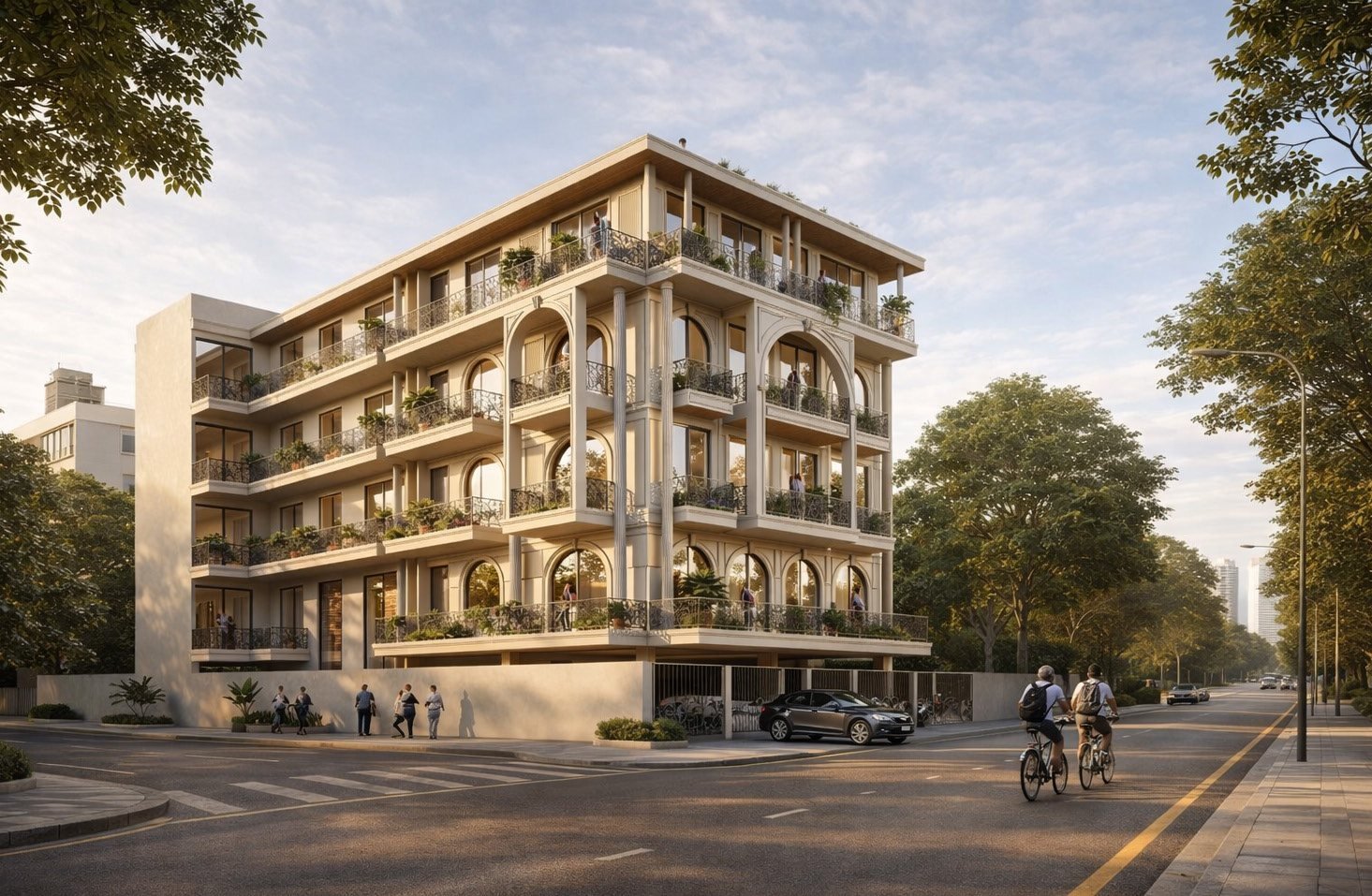
Stand in the first-floor drawing room of a mixed use building in Delhi and look down at the street. If the ground floor below is a chemist, a bakery or a lawyer’s office, the agent will call it mixed use and move on to the kitchen. That one phrase decides more about the floor you are buying than the cabinets do.
Mixed use is a permission, not a description. It has named routes, a floor on which each route may operate, an area limit and a parking condition. Get the route wrong and what you bought is a residential floor above an unauthorised shop, in a building whose sanction is now open to question.
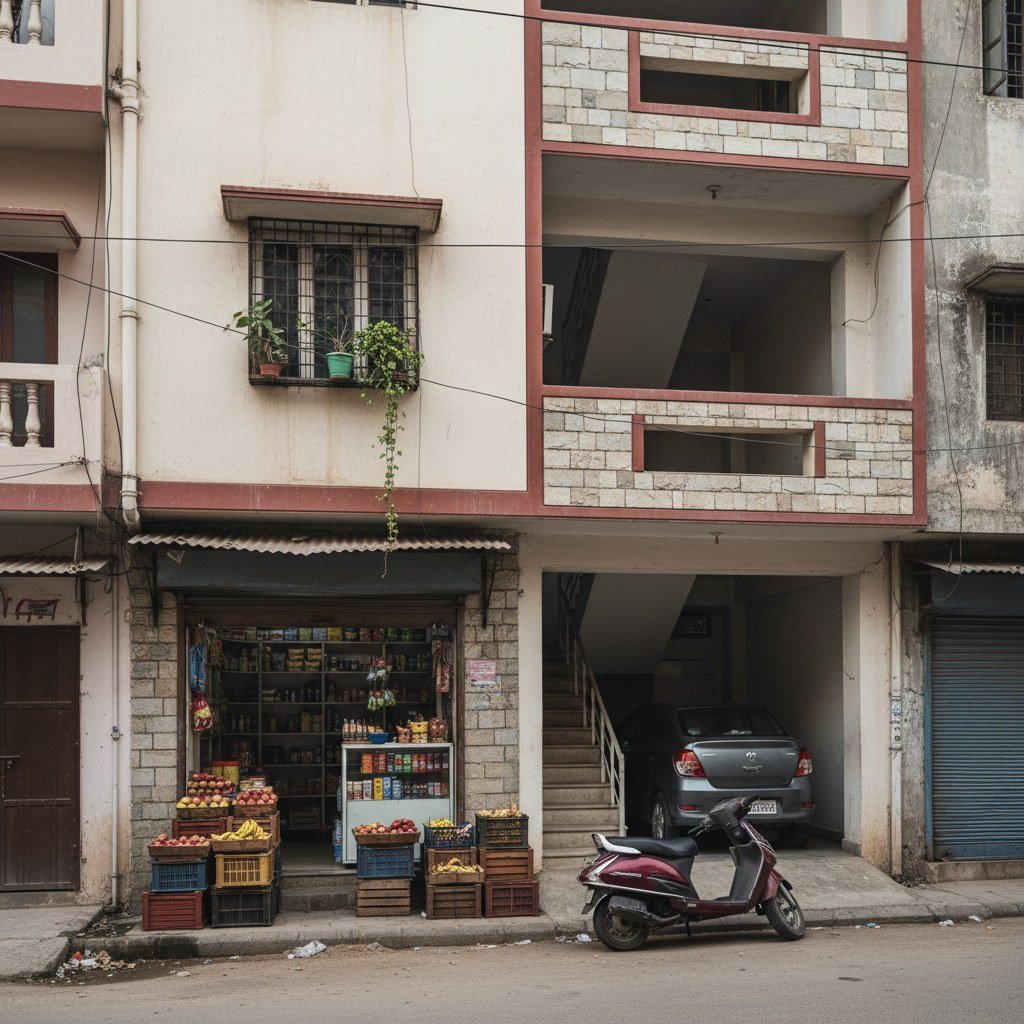
What a mixed use building in Delhi is allowed to do
Non-residential activity inside residential premises is governed by clause 13.4 of the Master Plan for Delhi 2047, in force since 20 August 2026 and replacing the 2021 plan. The clause does not throw the colonies open. It allows a small number of defined uses, each tied to a colony category, a road width and a floor.
Two changes matter to a buyer of the floors above. First, no new mixed-use or commercial streets will be notified during the plan period. The 2,183 mixed-use streets and 355 commercial streets already notified continue with the activities already permitted on them. Second, a residential plot on a road 30 m wide or more may now carry commercial activity on the ground floor, or on the first lower floor where the building has stilt parking, in every colony category, even if the road is on neither list, on payment of charges.
Outside those routes, converting a floor from residential to commercial is barred by section 347 of the Delhi Municipal Corporation Act unless the Commissioner permits it in writing. A shop trading outside the rules is not a fee to be settled later. It is a sealing notice waiting for a complaint.
The four ways a ground floor may lawfully trade
| Route | What it allows | What you should see on paper |
|---|---|---|
| Professional activity | A doctor, lawyer, architect, chartered accountant, engineer or similar professional, on any one floor, within less than half the sanctioned or permissible floor area | A plan that shows the use, and a practice record naming the professional |
| A small shop | Ground floor only, one shop of up to 20 sq m, from a closed list of trades: vegetables and fruit, kirana, dairy, chemist, bakery, stationery, salon, tailoring, laundry, photo studio, ATM and similar | The MCD registration of the non-residential use, and the trade on that list |
| Other activities | A clinic, nursing home, coaching centre, guest house or small hostel, on a plot of a minimum size abutting a road of the prescribed width | The plot size and road width against the schedule, not against the agent’s memory |
| A notified street | On a mixed-use street, the ground floor only. On a commercial street, the whole permissible floor area. Plus the 30 m road route under the 2047 plan | The notification for that road, printed, and the charges paid |
Every route carries the same two conditions. The use must be registered with the MCD and the charges paid. And parking has to be provided at 2.0 ECS for every 100 sq m of non-residential area, with no relaxation, inside the plot or in an approved common facility.
What a shop below does to the floor you are buying
- Parking. The parking condition is met out of the same stilt that serves four homes. Count the bays drawn on the sanctioned plan, not the cars standing on the ground on a Sunday morning.
- The entry. A shop needs frontage, so the gate, the staircase and often the lift landing end up shared with customers. Ask whether the building has a residential entrance you can lock at night.
- Hours. A bakery starts at four in the morning; a chemist takes stock after eleven at night; a coaching centre empties forty teenagers at once. None of that is a defect, and all of it is your daily life.
- Water and drainage. A shop adds a kitchen, a washroom or a grease trap to the same slab that is your ceiling. Seepage from below arrives before seepage from above ever does.
- Fire load. Stock, packing and footfall change what the building has to be able to do in a fire. The shop’s compliance is not separate from yours; it is the same staircase.
The two checks that settle it
First, the road. The MCD publishes the notifications for mixed-use and commercial streets, and the circular on approving building plans on those streets. A road that is wide, busy and lined with shops is not notified because of any of those things. It is notified because there is a notification, and the notification names the activities allowed on the ground floor.
Second, the plan. The sanctioned plan shows the use sanctioned at each level. If the plan draws a residential ground floor and a shop is trading there, the shop is unauthorised whatever licence the shopkeeper holds. Reading a sanctioned plan in Delhi is a specific exercise: the plan, the approval number and the municipal record have to agree, and an old plan is not proof of what is standing today.
Both are worth doing before token money, and both are cheaper than the alternative. Our guides to checking a sanctioned building plan and to MCD unauthorised construction set out what to ask for and where the record sits.
What the Supreme Court settled in 2025
In M.C. Mehta v. Union of India, decided on 31 October 2025, the Supreme Court refused to de-seal a shop-cum-residence plot in New Rajinder Nagar where the upper floors, sanctioned for residence, were being run commercially. The owner was told to remove the non-compoundable work and pay conversion charges for the upper floors before asking for the seal to be lifted. A building can be lawfully mixed at ground level and unlawful one floor up.
In South Delhi Municipal Corporation v. Bharat Bhushan Jain, decided on 6 November 2025, the court held that an owner on a notified street cannot be compelled to build a commercial unit on the ground floor. The permission is enabling, not mandatory. A ground floor that stays residential is lawful, and a residential ground floor is not a defect in the building.
Read together, the two decisions say one thing to a buyer: the lawful use is the one on the sanctioned plan and in the notification for that road. Everything else, including the shop’s own paperwork, is beside the point.
What it does to a loan and to resale
A lender values the use the deed and the plan support. Where the shop below is trading without registration, or on a road that was never notified, the exposure does not stop at the shutter. A sealing or demolition notice on the ground floor puts the building’s sanction, its fire compliance and the next buyer’s appetite in question at the same time, and a valuer will price that in.
On resale, a lawful shop is a feature and an unlawful one is a story the next buyer has to be told. The difference between the two is a file, not a trade.
When a shop below is worth having
For a household with elderly parents, a chemist, a dairy and a kirana inside the gate save a car trip every week. A floor above an ATM, a clinic or a small office on a notified street rents to a wider pool of tenants, because that tenant is buying convenience rather than quiet. A professional’s office, a lawyer or an architect, is the least intrusive neighbour a ground floor can have: one door, no stock, no delivery van.
What you keep either way is the thing a gated flat cannot offer. One home to a floor, no corridor, no shared lobby, and a door that opens onto your own landing.
The file to read in one sitting
Ask for all of it at once, before the token:
- The sanctioned plan, with the use shown at each level
- The MCD registration of the non-residential use, and the receipt for the charges paid
- The shop’s trade licence, and the trade checked against the permitted list
- The deed of your floor, including its schedule of the undivided land share
- The property tax record, showing the same use as the plan
- The notification for the road, printed from the MCD record
A seller who produces that set in an afternoon is selling a floor above a lawful shop. A seller who has the deed and a shrug is selling you a question the bank will ask again at valuation.
The floors we build at Nayab, Samriddhi, Sukoon, Unnati, Utkarsh and LUXE Horizon are sold as whole floors with a defined share of the land, one home to a level, and the documents come as a set. See the floors available across Vasant Kunj, Vasant Enclave and Nangal Dewat and request price and availability. We will send you the current price and which floors are open, in writing.